Ultherapysave ~45–60%
- Reaches SMAS
- Yes
- Discomfort
- Higher
- Korea · full face
- S$2,270–3,140
- Singapore
- S$3,200–4,800
- Best for
- Strongest evidence
Skin & Lifting · Singapore
A Singaporean's cost and comparison guide, 2026.
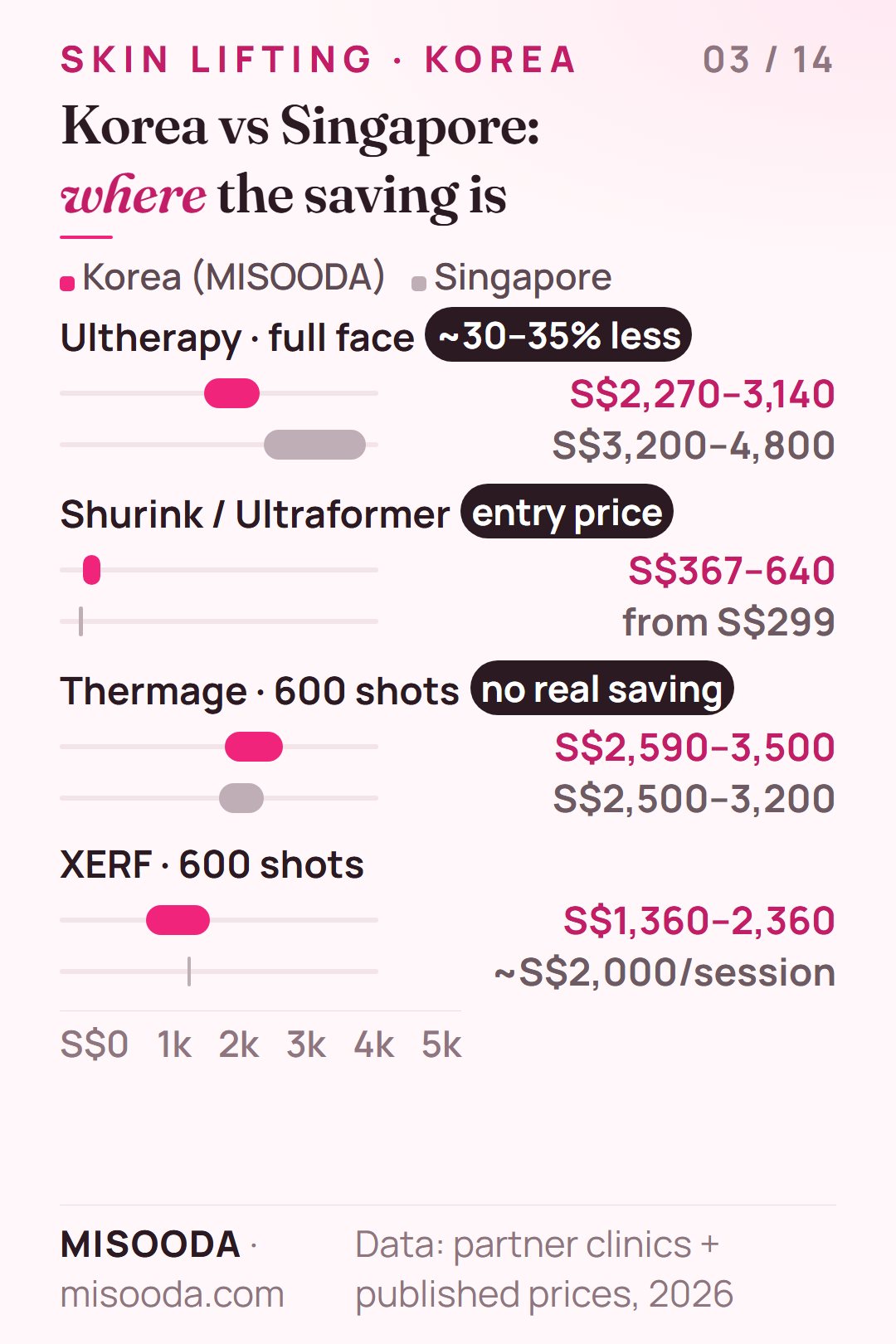
Short answer. A full face runs about S$2,270–3,140 for Ultherapy in Korea against S$3,200–4,800 in Singapore — roughly 30–35% less. Thermage is the exception: at S$2,590–3,500 in Korea against S$2,500–3,200 here, there is no real saving, and we would rather say so than sell you a flight. Ultherapy, Shurink and Thermage are bookable through MISOODA partner clinics; XERF is not yet.
Read this first
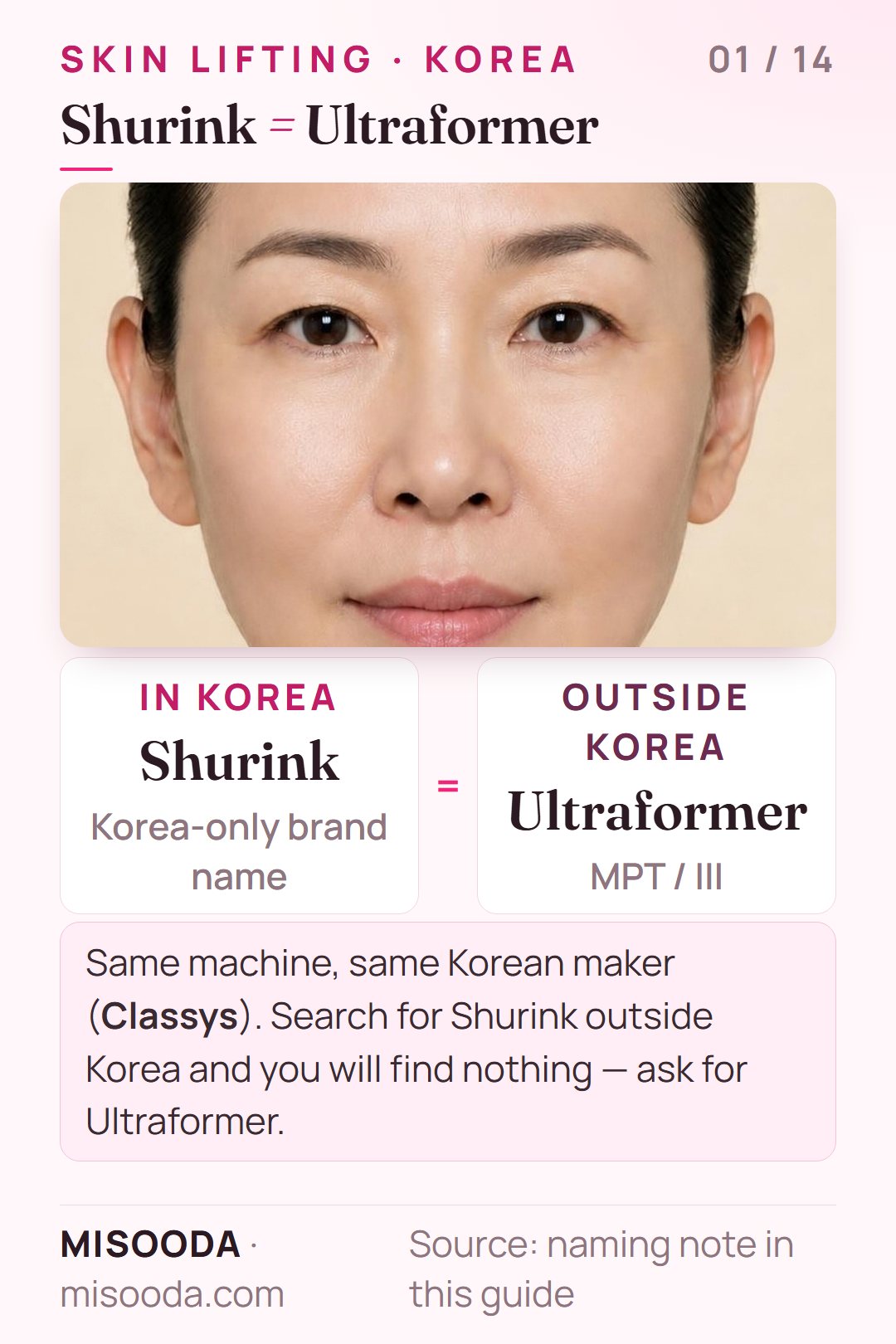
“Shurink” is a Korea-only brand name.
The same device, from the same Korean manufacturer (Classys), is sold in Singapore as Ultraformer (MPT / III).
So if you read about Shurink and then search for it in Singapore, you will find nothing. Ask for Ultraformer. Same machine.
Quick pick
If you only read one section, read this one.
Full comparison
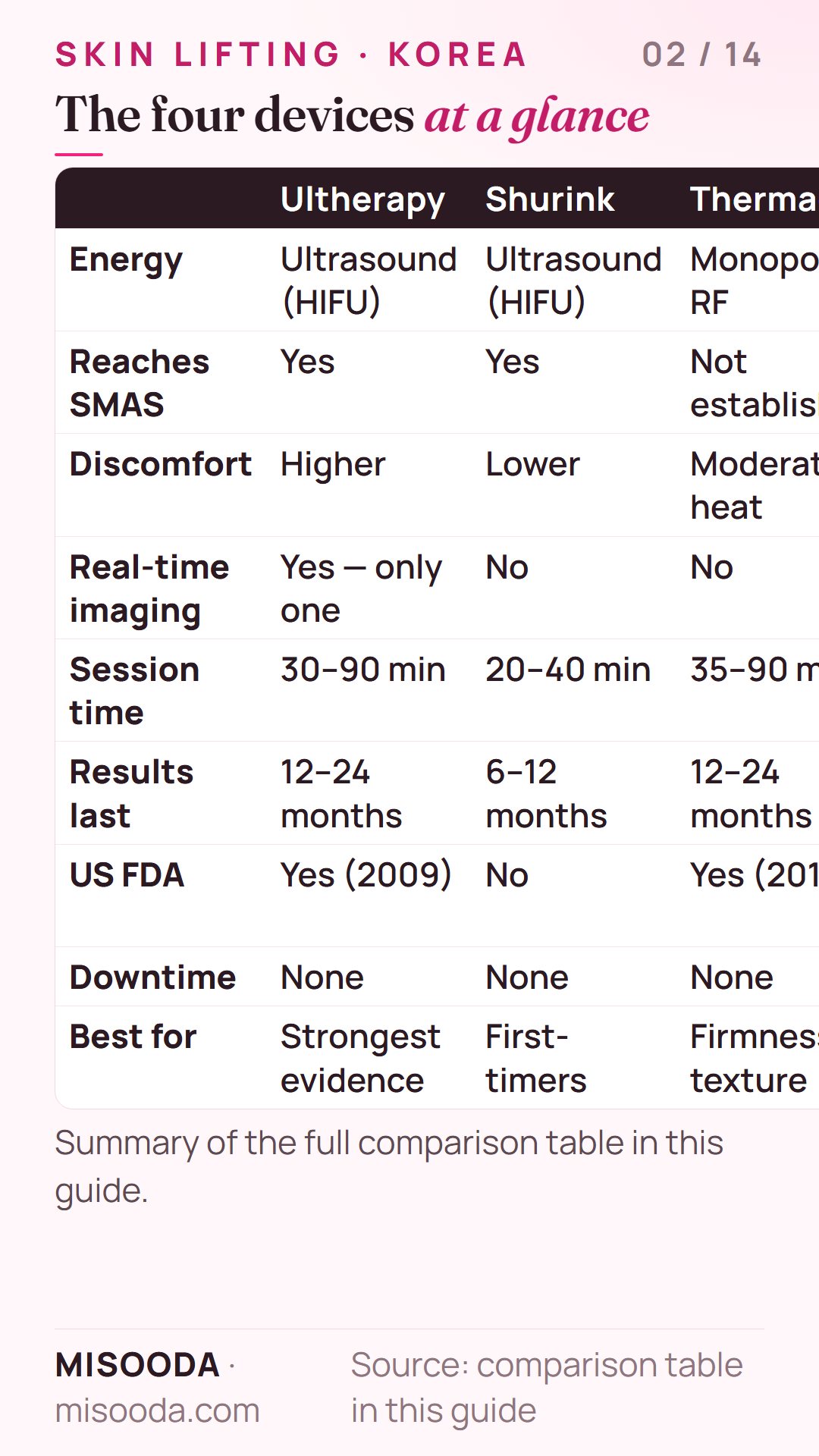
Swipe the table sideways for all eleven points.
| Ultherapy | Shurink | Thermage | XERF | |
|---|---|---|---|---|
| Energy | Ultrasound (HIFU) | Ultrasound (HIFU) | Monopolar RF | Monopolar RF, dual |
| Maker | Merz (US) | Classys (Korea) | Solta (US) | Cynosure Lutronic (Korea) |
| Reaches SMAS | Yes | Yes | Not established | Yes |
| Real-time imaging | Yes — only one | No | No | No |
| US FDA cleared | Yes (2009) | No | Yes (2017) | Yes (2025) |
| Discomfort | Higher | Lower | Moderate heat | Lower |
| Session time | 30–90 min | 20–40 min | 35–90 min | 15–60 min |
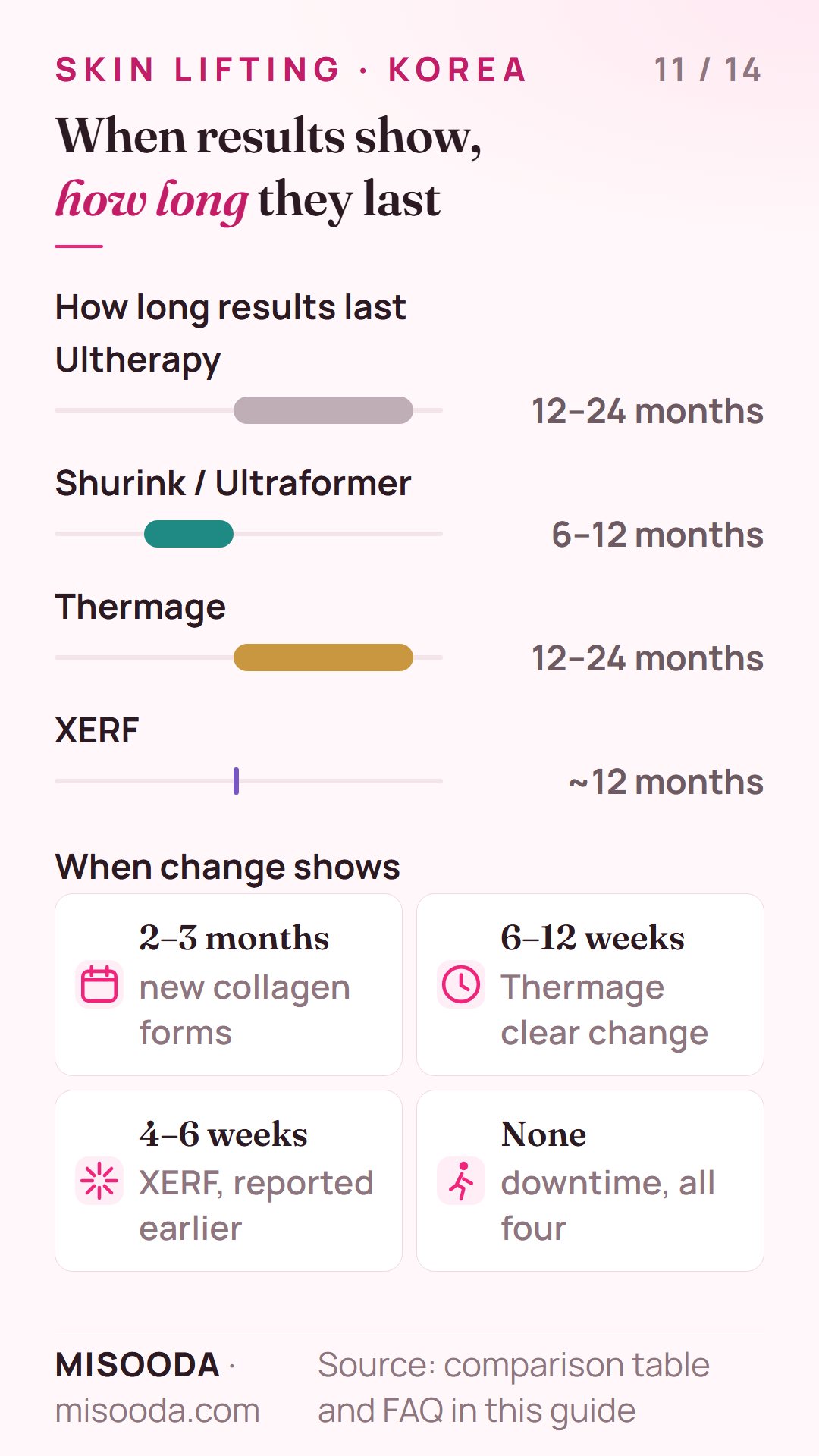
| Results last | 12–24 months | 6–12 months | 12–24 months | ~12 months |
| Downtime | None | None | None | None |
| Korea price 600 shots | ₩2.5–3.45m | ₩400–700k | ₩2.85–3.85m | ₩1.5–2.6m |
| Book via MISOODA | Yes | Yes | Yes | Not yet |
Where the Korean numbers come from. Ultherapy and Thermage are the middle band of what MISOODA partner clinics actually charge — the 25th to 75th percentile across our clinic price lists, VAT included, with packages and campaign rates excluded. They are ranges rather than fixed prices because we work with more than one clinic and route you accordingly. Shurink and XERF are published market rates instead, because our partner price lists do not yet cover them, and we would rather label that than pretend otherwise. Singapore figures are published clinic prices as at August 2026 and are deliberately left wide, because that is the real spread there; clinics there often quote “from” or per-session prices without shot counts, so some rows are not strictly like-for-like. Converted at S$1 ≈ ₩1,100 and US$1 = ₩1,400.
Depth
The layer everyone mentions
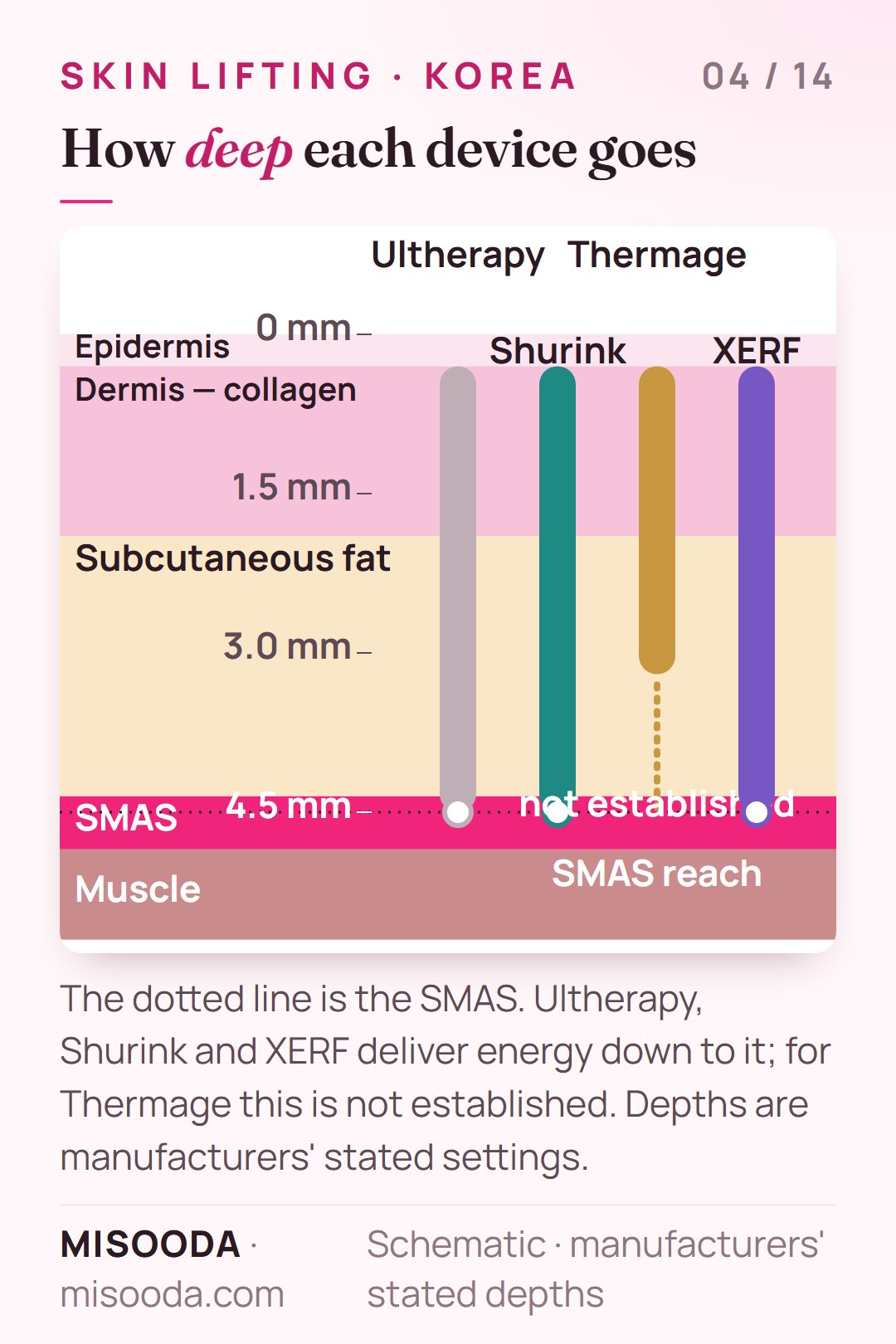
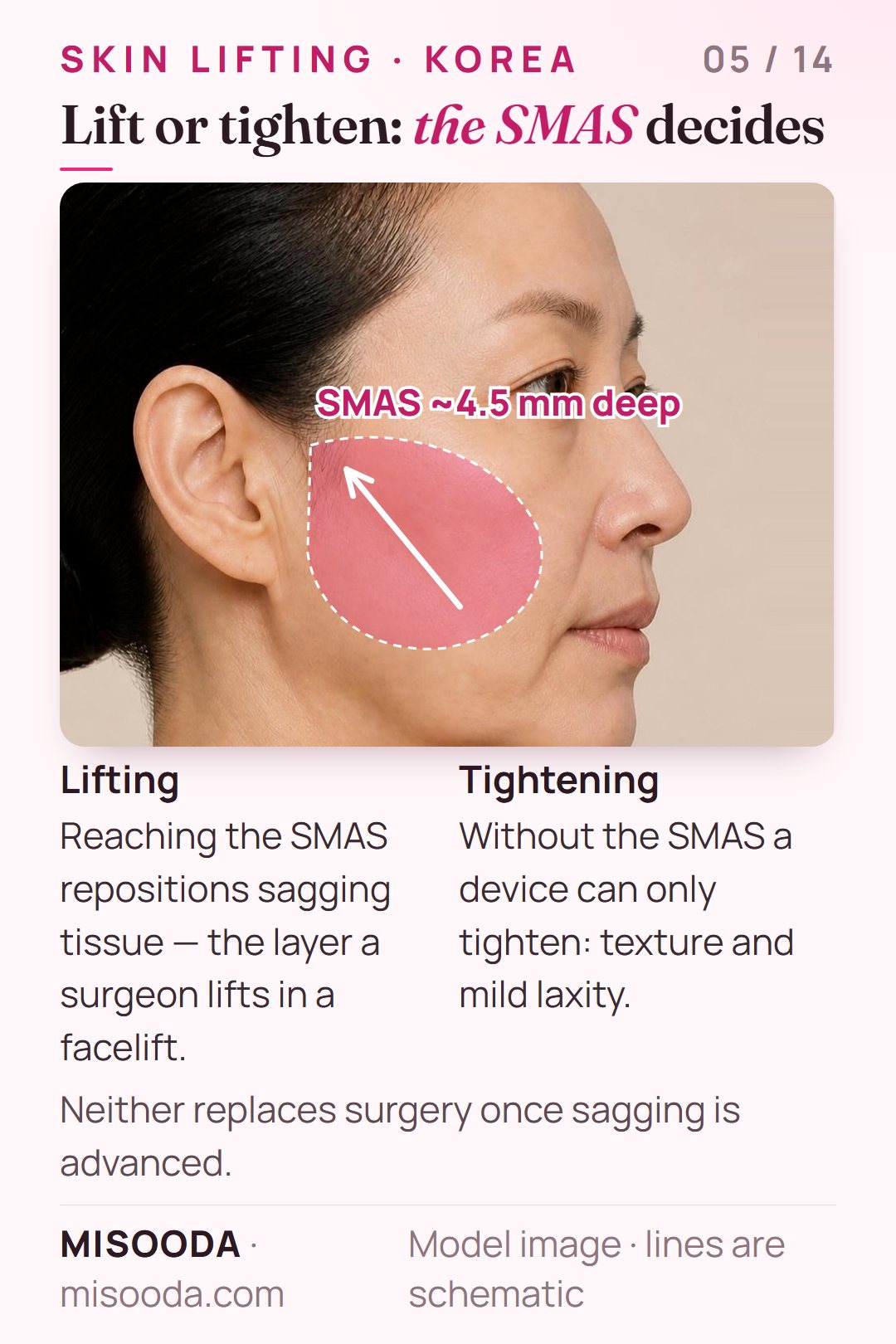
The SMAS (superficial musculoaponeurotic system) is a sheet of fibrous tissue and muscle sitting roughly 4.5 mm below the surface. It is the layer a surgeon lifts during a facelift.
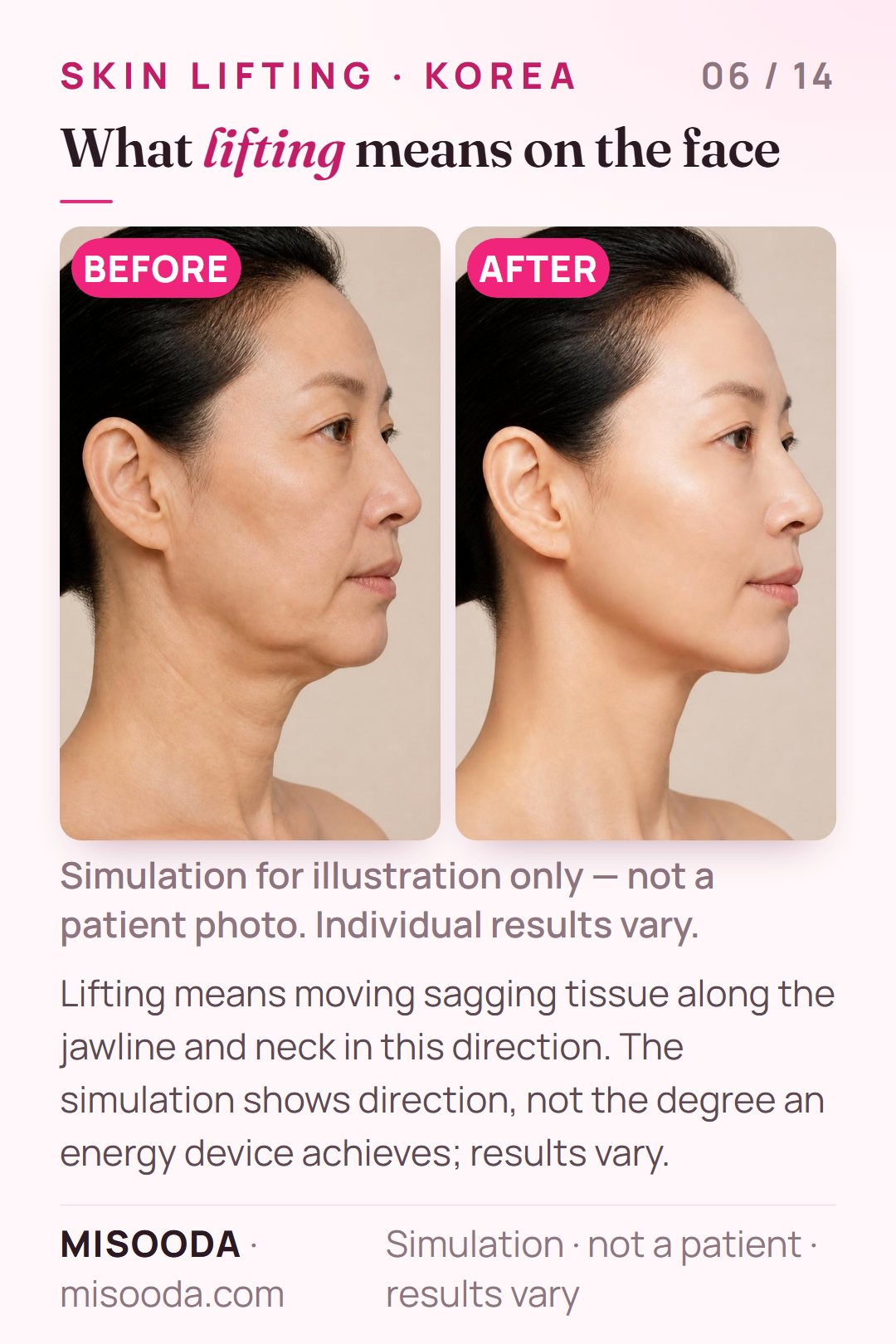
That is why it matters: if a device cannot reach the SMAS, it cannot lift — only tighten. Tightening improves texture and mild laxity. Lifting repositions sagging tissue. Neither replaces surgery once sagging is advanced.
Device by device
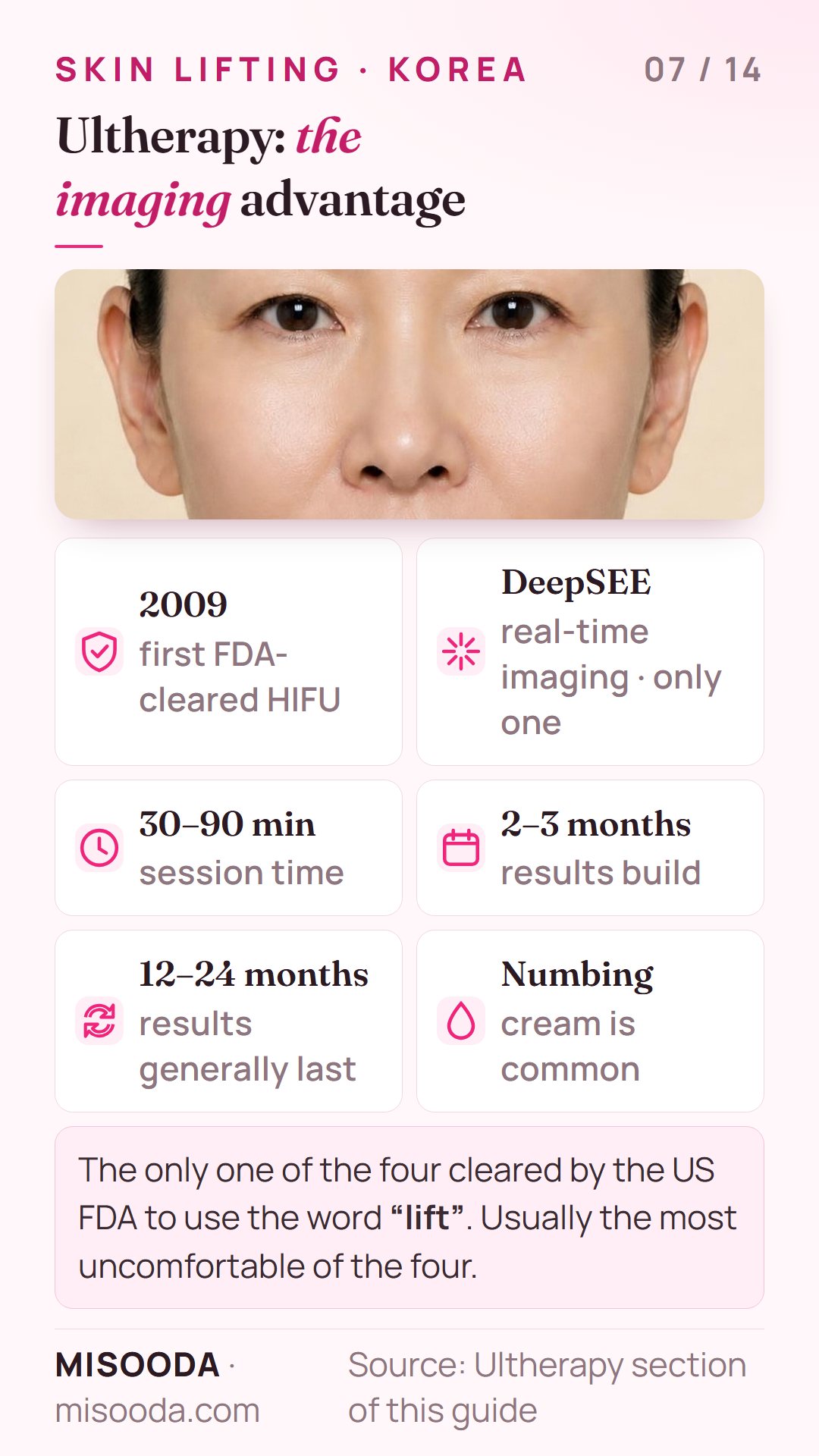
The original FDA-cleared HIFU device (2009). Its distinguishing feature is DeepSEE real-time ultrasound imaging — the doctor sees the tissue layers on screen while treating, rather than firing at a preset depth. None of the other three offer this.
It is also the only one of the four cleared by the US FDA to use the word “lift”. Treatment is usually the most uncomfortable of the four, and numbing cream is common. Results build over 2–3 months and generally last 12–24 months.

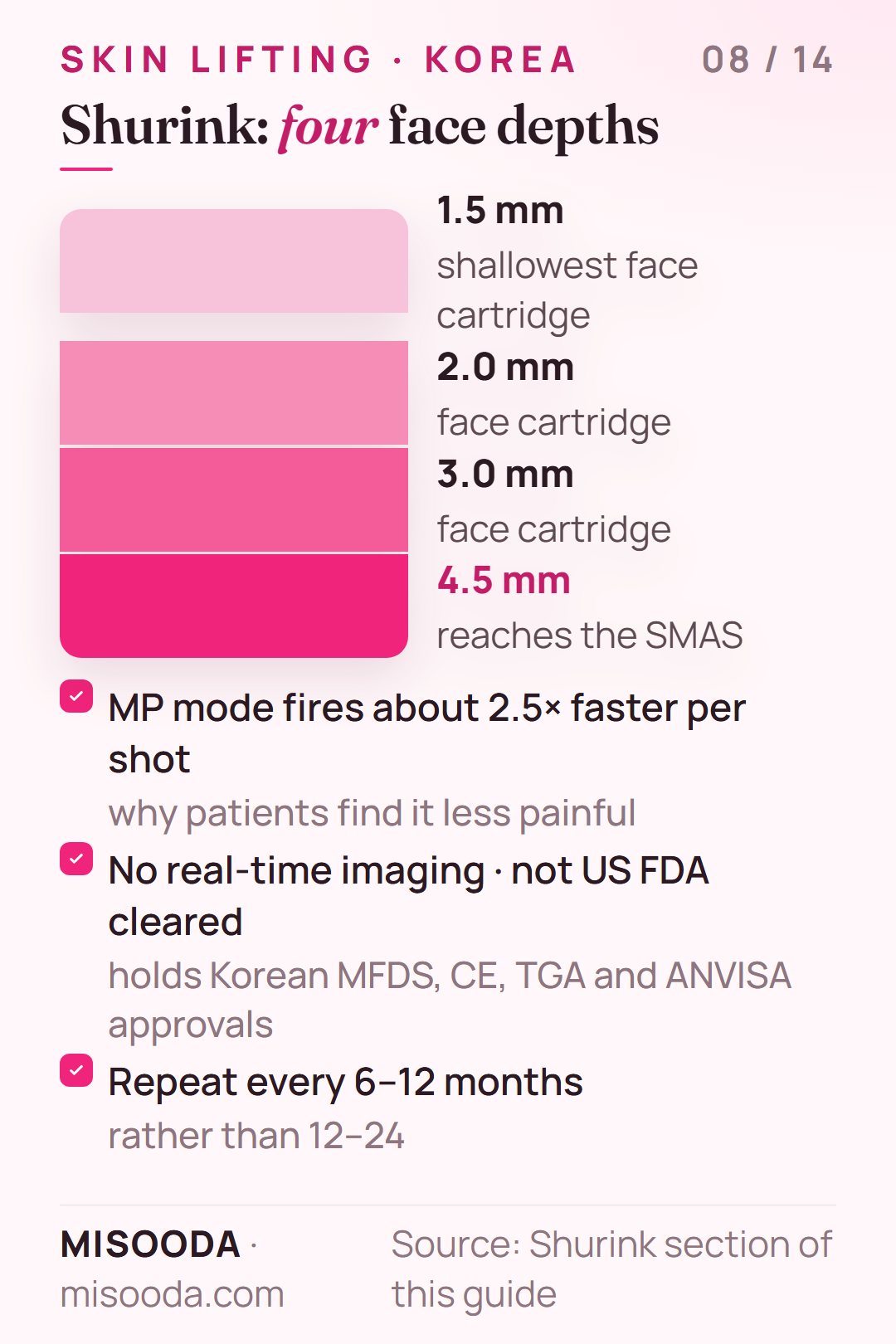
Made by Classys in Korea. Same ultrasound principle as Ultherapy, with a wider cartridge range (1.5 / 2.0 / 3.0 / 4.5 mm for the face, plus body cartridges). Its MP mode fires about 2.5× faster per shot, which is why patients report it as noticeably less painful.
Two honest caveats: it has no real-time imaging, and it is not US FDA cleared (it holds Korean MFDS, CE, TGA and ANVISA approvals; a newer model is in US trials). It also needs repeating more often — every 6–12 months rather than 12–24.
Radiofrequency rather than ultrasound. Instead of focused points at set depths, it heats dermal and subcutaneous tissue volumetrically. Patients describe heat rather than sharp pain. Numbing cream is often skipped — some clinicians argue it is actively unhelpful, because feeling the heat is part of how the operator avoids burns.
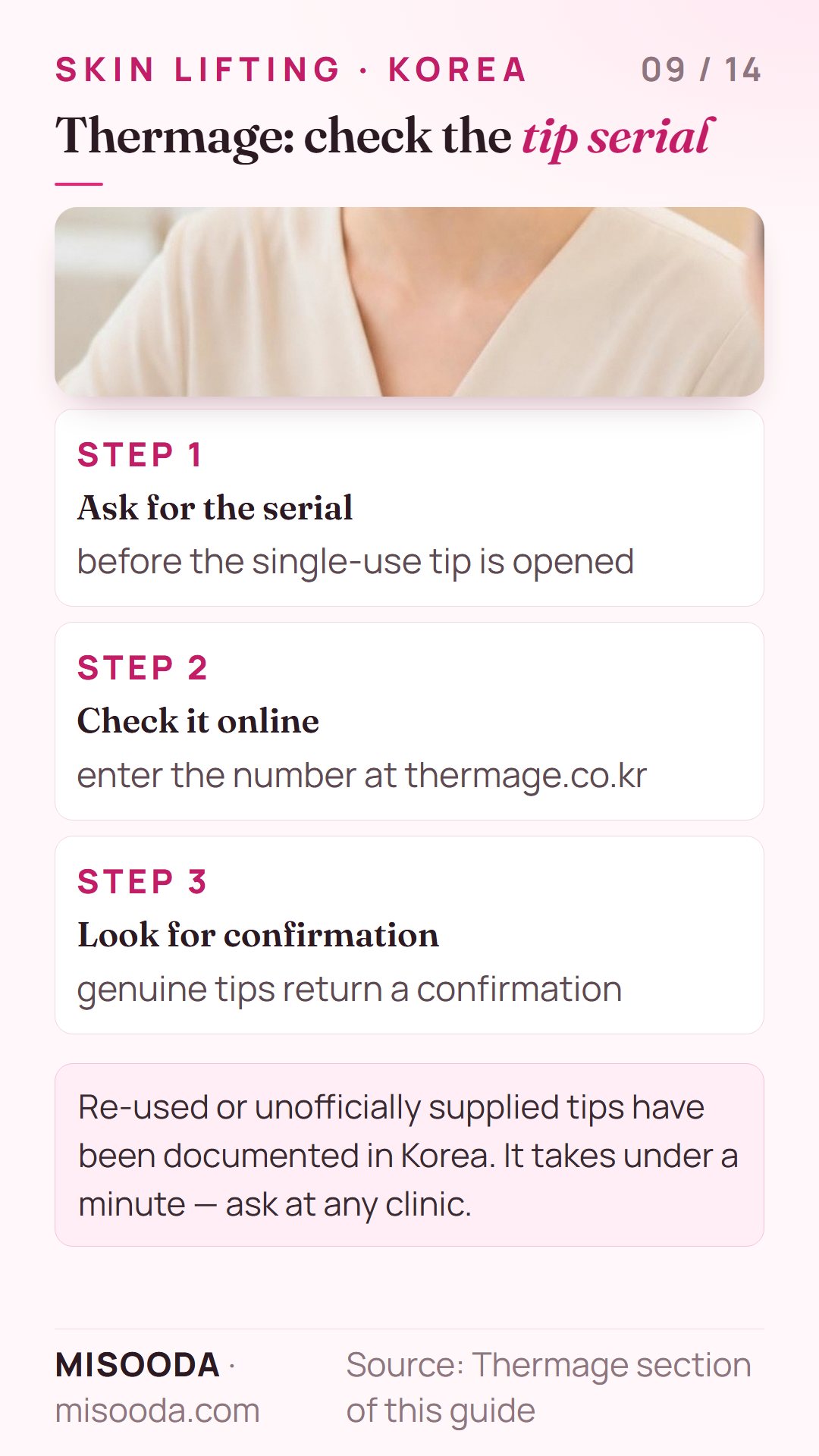
Thermage tips are single-use consumables with a limited window after opening. In Korea there have been documented cases of tips being re-used or supplied outside official channels.
You can verify this yourself in under a minute. Before the tip is opened, ask for its serial number and enter it at thermage.co.kr. Genuine tips return a confirmation.
Every MISOODA partner clinic uses genuine tips and will show you the packaging. We would rather you ask — at any clinic, including ours.
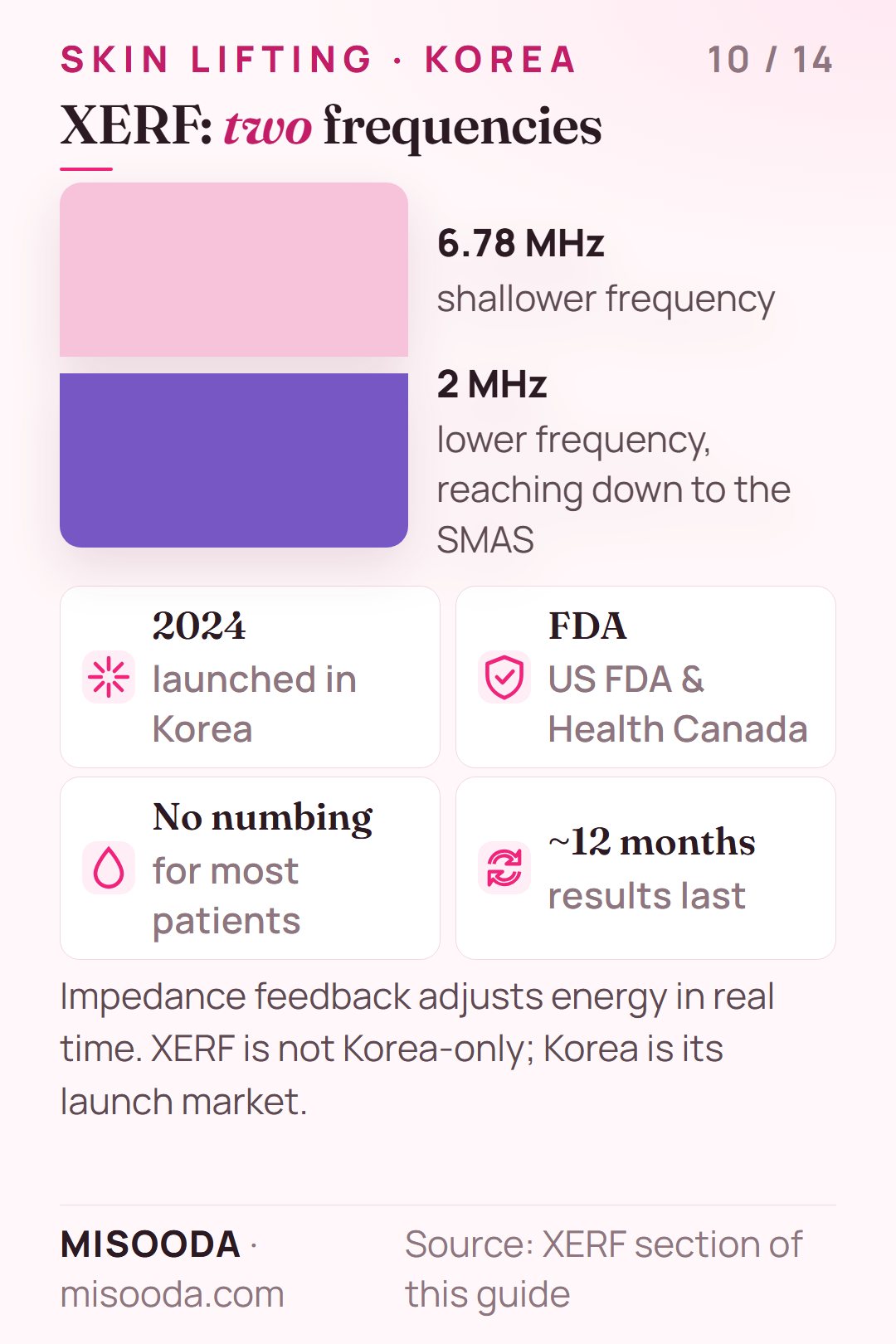
The newest of the four, developed in Korea by Lutronic (now Cynosure Lutronic) and launched here in 2024. Monopolar RF like Thermage, but running two frequencies — 6.78 MHz and 2 MHz — with the lower one reaching deeper, down to the SMAS. Impedance feedback adjusts energy in real time, and most patients need no numbing.
One correction, since some articles get this wrong: XERF is not Korea-only. Several Singapore clinics already offer it, and it holds US FDA and Health Canada clearance. What Korea offers is being the launch market — more clinics, more operator experience, more price competition.
Choosing
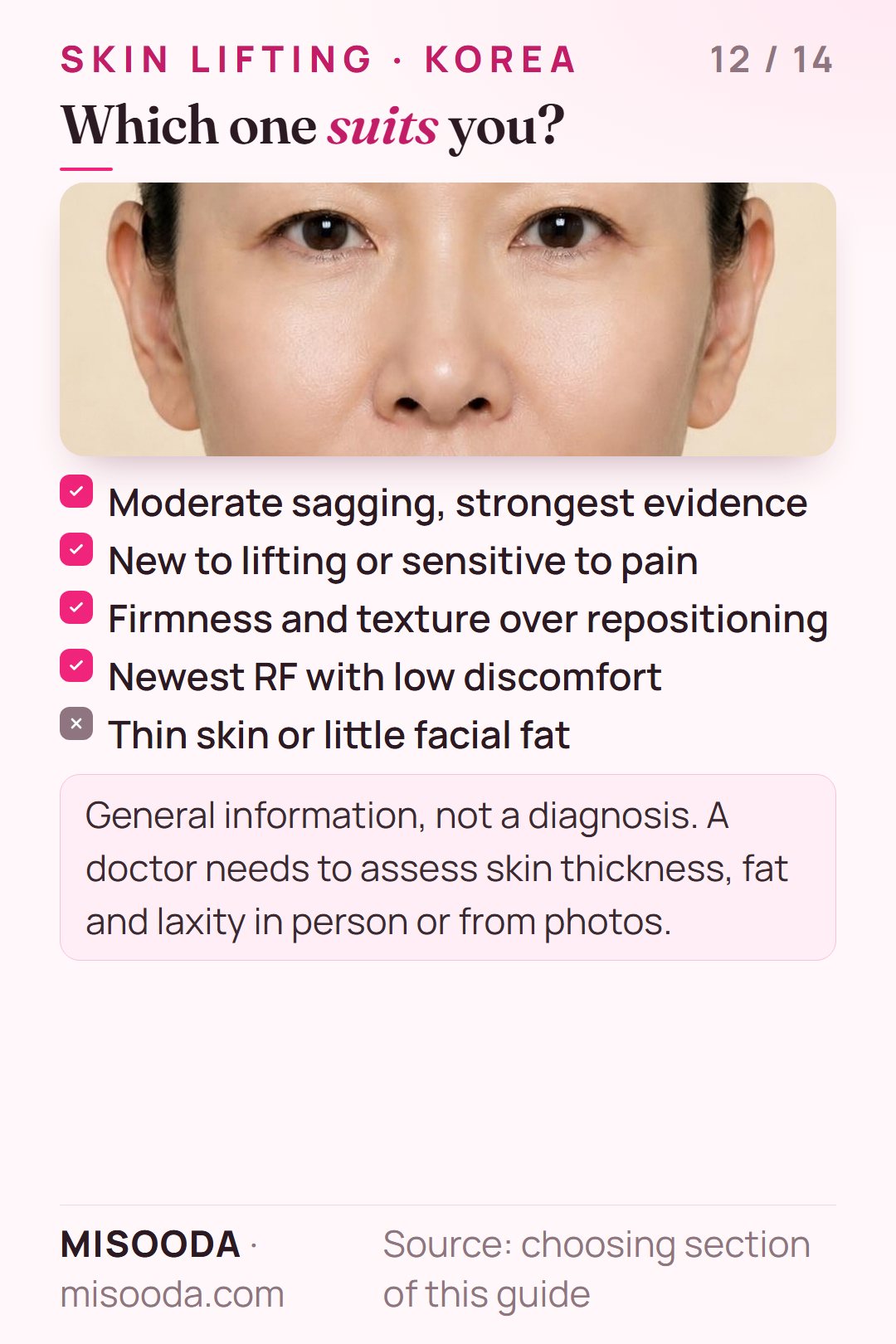
General information, not a diagnosis. Suitability depends on skin thickness, fat distribution and degree of laxity — a doctor needs to assess this in person or from clinical photographs.
Safety
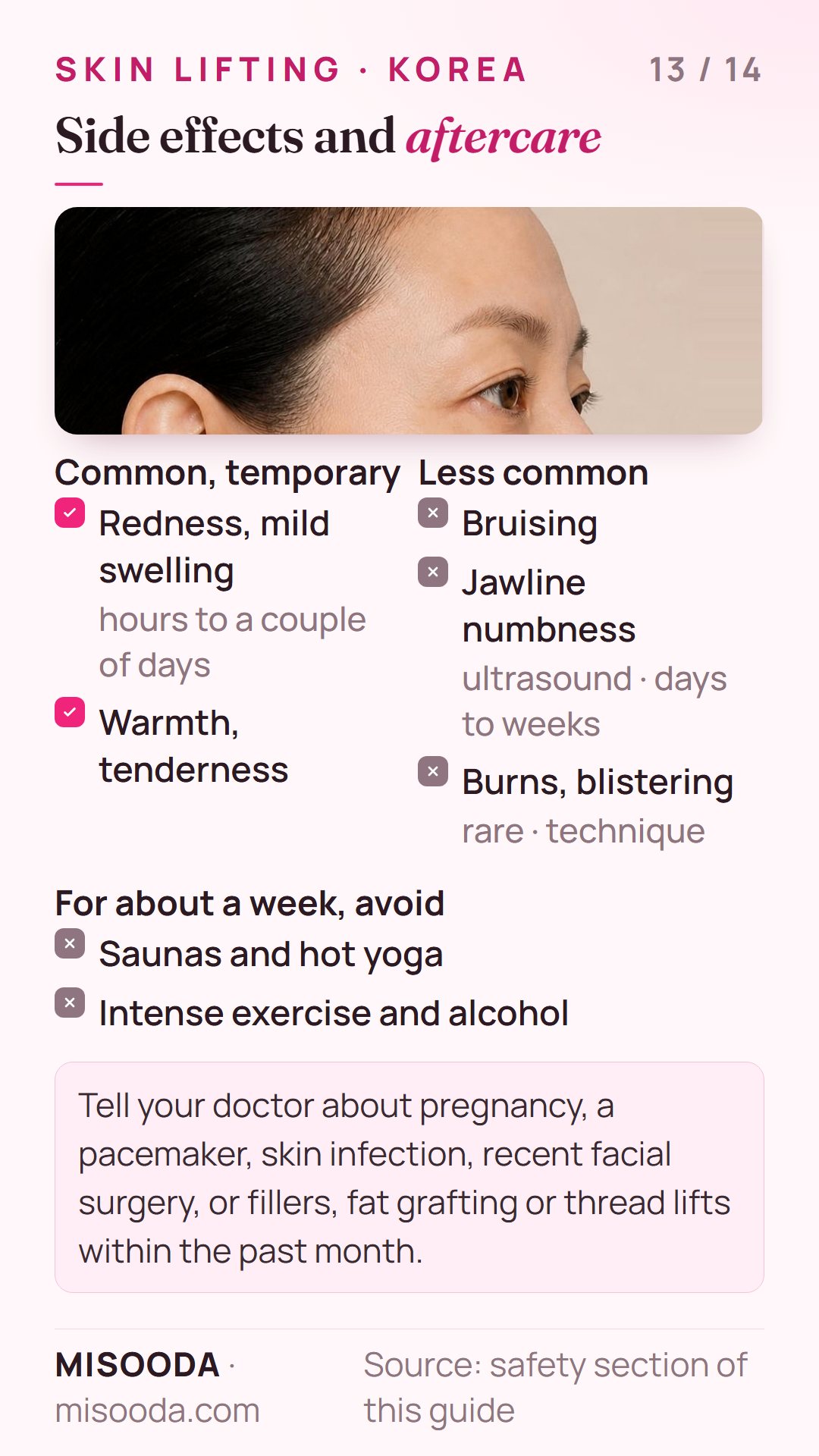
Common, temporary, all four: redness, mild swelling, warmth, tenderness — usually settling within hours to a couple of days.
Less common: bruising; temporary numbness or tingling along the jawline with ultrasound devices, resolving over days to weeks; and rarely — usually linked to technique or excessive settings — burns, blistering or contour irregularity.
Tell your doctor if you are pregnant or breastfeeding, have an active skin infection or open wound in the area, carry an implanted electronic device such as a pacemaker, have had recent facial surgery, or have had fillers, fat grafting or thread lifts in the same area within the past month.
Afterwards: avoid saunas, hot yoga, intense exercise and alcohol for about a week. Normal cleansing and make-up are fine the same day.
Budget
A realistic Korea budget includes return flights, 2–4 nights in Gangnam or Myeongdong, local transport, and a buffer for anything your doctor recommends after seeing your skin. Non-surgical lifting has no downtime, so most visitors fold it into a normal trip rather than booking recovery days.
Korea’s VAT refund for cosmetic procedures ended on 1 January 2026. Any page still promising a 7–10% airport refund on aesthetic treatments is out of date.
Booking
Ultherapy, Shurink and Thermage are available at every MISOODA partner clinic, and XERF is available too. That is unusual — most agencies route you to whichever clinic happens to own the machine, which limits your choice of doctor.
Send your photos and what bothers you. You get an itemised quote across suitable clinics — same price a Korean local pays, no mark-up, interpreter included.
Want one specific device? Say so, and we will confirm which partner clinics offer it before anything is booked.
FAQ
Yes. Both are made by Classys in Korea. "Shurink" is the domestic Korean brand name; the same device is sold internationally, including in Singapore, as Ultraformer MPT or III.
They use the same underlying technology and both reach the SMAS at 4.5 mm. Ultherapy adds real-time ultrasound imaging and holds US FDA clearance including the word "lift", and results typically last 12–24 months. Shurink is more comfortable, faster and considerably cheaper, but generally needs repeating every 6–12 months.
About 30–35% less. A 600-shot full face runs roughly S$2,270–3,140 across MISOODA partner clinics in Korea, against S$3,200–4,800 in Singapore for full face and neck at 800–1,200 lines. The shot and line counts differ, so treat this as a guide rather than a quote — and note that this is our standing price band, not a campaign rate.
Barely, and we would rather tell you that. At standing prices across our partner clinics a 600-shot Thermage FLX face treatment is about S$2,590–3,500 in Korea against S$2,500–3,200 in Singapore, so the saving is not the reason to have it done here. Ultherapy is where the gap is real. If you do choose Thermage in Korea, ask the clinic to show you the tip serial number before the tip is opened — that is worth more to you than a discount.
Honestly, no. Shurink/Ultraformer is inexpensive in both countries and the gap does not cover a flight. It makes more sense as an add-on to a trip you are already taking.
Yes. Several Singapore clinics offer it, and it holds US FDA and Health Canada clearance. Korea's advantage is being the launch market — more clinics offering it and more price competition — not exclusivity.
Ultherapy and Shurink both do, via 4.5 mm cartridges, and XERF's 2 MHz frequency is stated to reach it. For Thermage this is not established in the clinical literature, despite some marketing claims.
Generally Shurink and XERF. Shurink's MP mode fires much faster per shot, and XERF uses a pulse pattern designed to reduce discomfort. Ultherapy is usually the most uncomfortable. Thermage is described as intense heat rather than sharp pain.
Commonly used for Ultherapy, optional for Shurink, and usually skipped for Thermage and XERF. For Thermage some clinicians prefer you skip it, since feeling the heat helps the operator avoid overtreating.
Roughly 12–24 months for Ultherapy and Thermage, 6–12 months for Shurink, and around 12 months for XERF. Ageing continues regardless, so these are maintenance treatments rather than one-time fixes.
There is often some immediate tightening, but the real change comes from new collagen forming over 2–3 months. Thermage typically shows clear change from 6–12 weeks; XERF is reported earlier, around 4–6 weeks.
No. All four are non-surgical with no recovery period. You may have redness or mild swelling for a few hours to a couple of days, but you can travel, work and wear make-up the same day.
Often yes, but sequencing matters — particularly around fillers, fat grafting and thread lifts, which generally need a gap. Tell us everything you are considering and the clinic will plan the order.
No. Korea's VAT refund for cosmetic procedures ended on 1 January 2026. Any site still advertising a 7–10% airport refund on aesthetic treatments is out of date.
Ask for the serial number before the tip is opened and check it at thermage.co.kr. Tips are single-use with a limited window after opening, and re-used or unofficially supplied tips have been documented in Korea. Any reputable clinic will be happy to show you.
Send photos and tell us what bothers you. You will get an itemised quote across suitable partner clinics, at the same price a Korean local pays.
Keep exploring