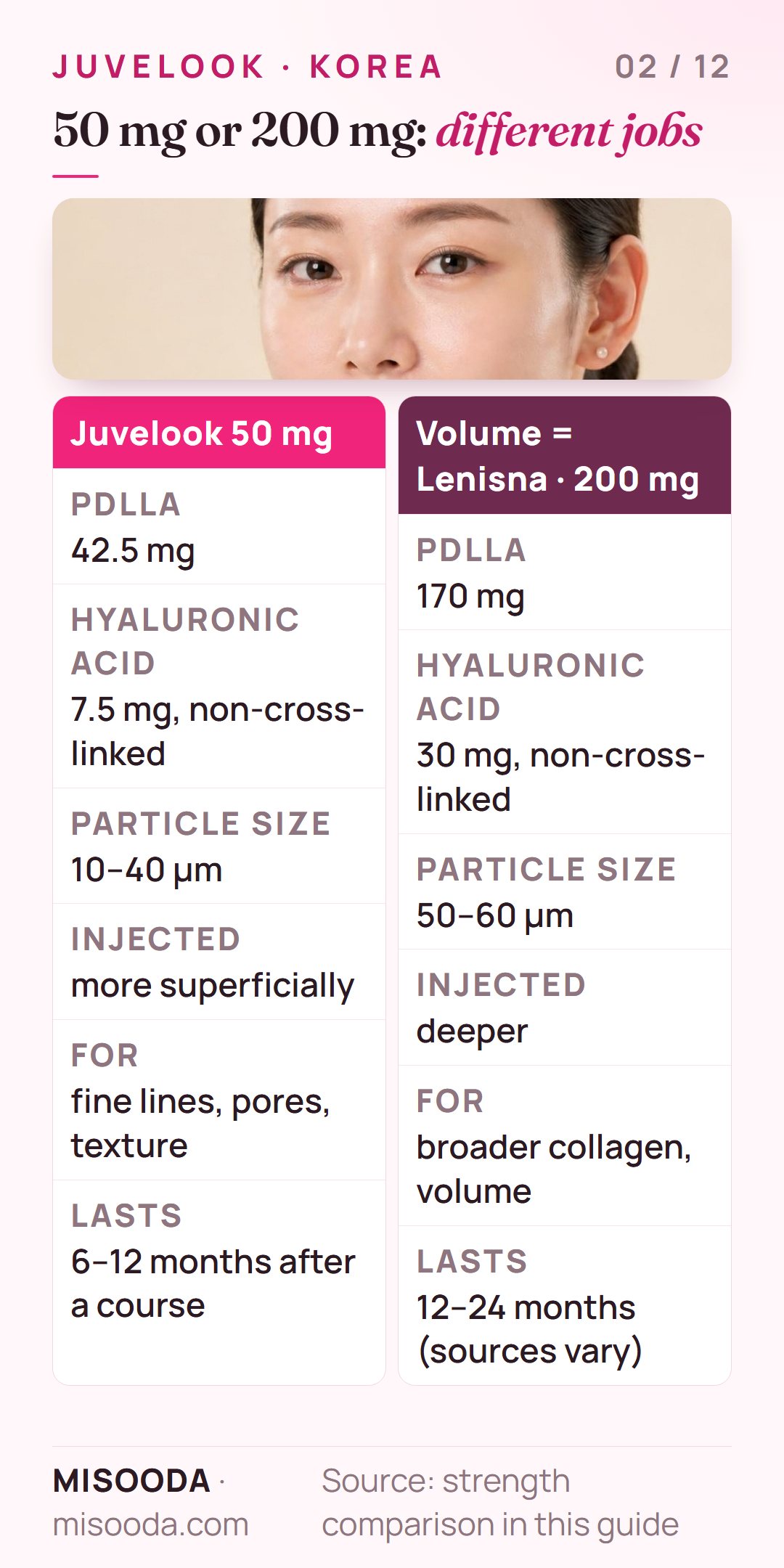
Juvelook 50 mgskin quality
- PDLLA
- 42.5 mg
- Hyaluronic acid
- 7.5 mg, non-cross-linked
- Particle size
- 10–40 µm
- Injected
- More superficially
- For
- Fine lines, pores, skin texture
- Lasts
- 6–12 months after a course
Skin & Injectables
A PDLLA skin booster cost and comparison guide, 2026.
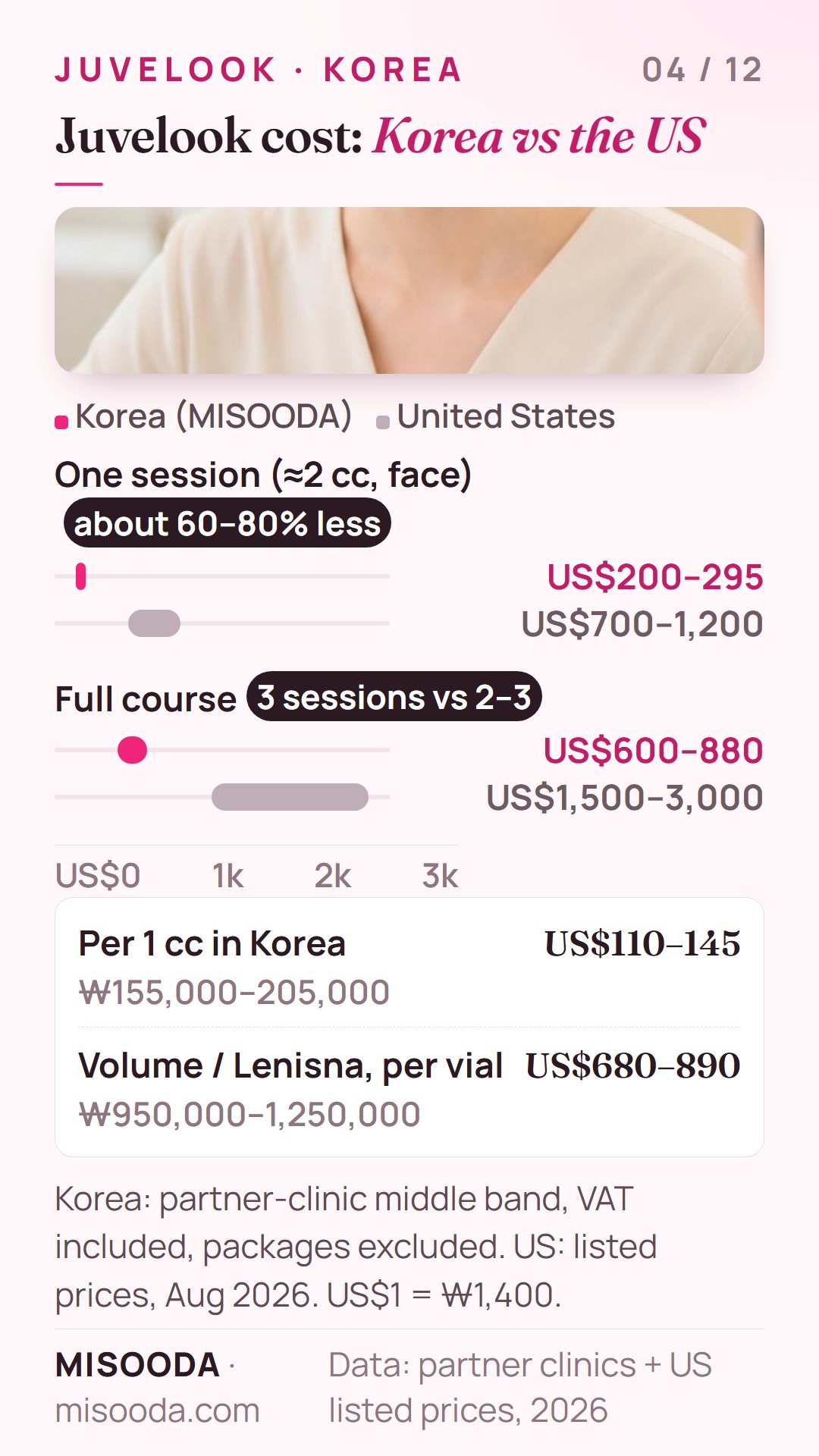
Short answer. A Juvelook session in Korea runs about US$200–295 against US$700–1,200 in the US — roughly 60–80% less. A full three-session course is about US$600–880. And Lenisna is not a rival product — it is Juvelook Volume under another name.
Read this first
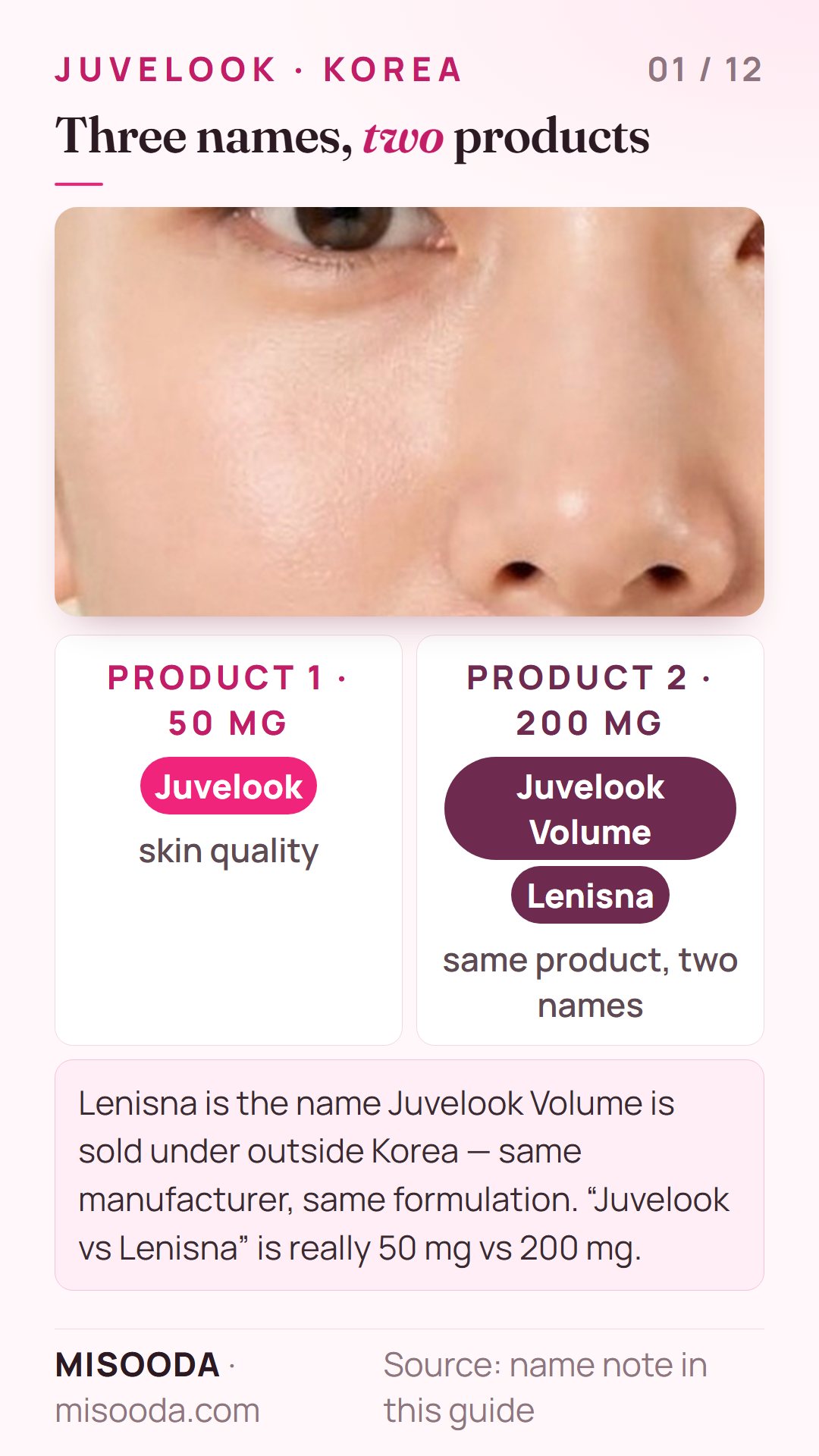
Juvelook, Juvelook Volume and Lenisna are not three products. They are two.
Lenisna is the name Juvelook Volume is sold under outside Korea. Same manufacturer, same formulation.
So when you see a clinic page comparing "Juvelook vs Lenisna" as if you had to pick a side, what you are actually choosing between is the 50 mg strength and the 200 mg strength of the same thing.
That distinction is worth getting right, because the two are for genuinely different jobs — and being quoted for the wrong one is the most common way people overpay for this treatment.
The two strengths
The two figures published for the Volume / Lenisna line differ by source — some say 12–18 months, others 18–24. We give the wider range rather than pick the flattering one.
Cost
Swipe the table sideways.
| 🇰🇷 Korea | 🇺🇸 United States | |
|---|---|---|
| Per 1 cc | ₩155,000–205,000 US$110–145 | Rarely quoted per cc |
| One session (≈2 cc, face) | ₩280,000–410,000 US$200–295 | US$700–1,200 |
| Full course | ₩840,000–1,230,000 US$600–880 (3 sessions) | US$1,500–3,000 2–3 session package |
| Volume / Lenisna (per vial) | ₩950,000–1,250,000 US$680–890 | — |
| You save vs Korea | — | about 60–80% |
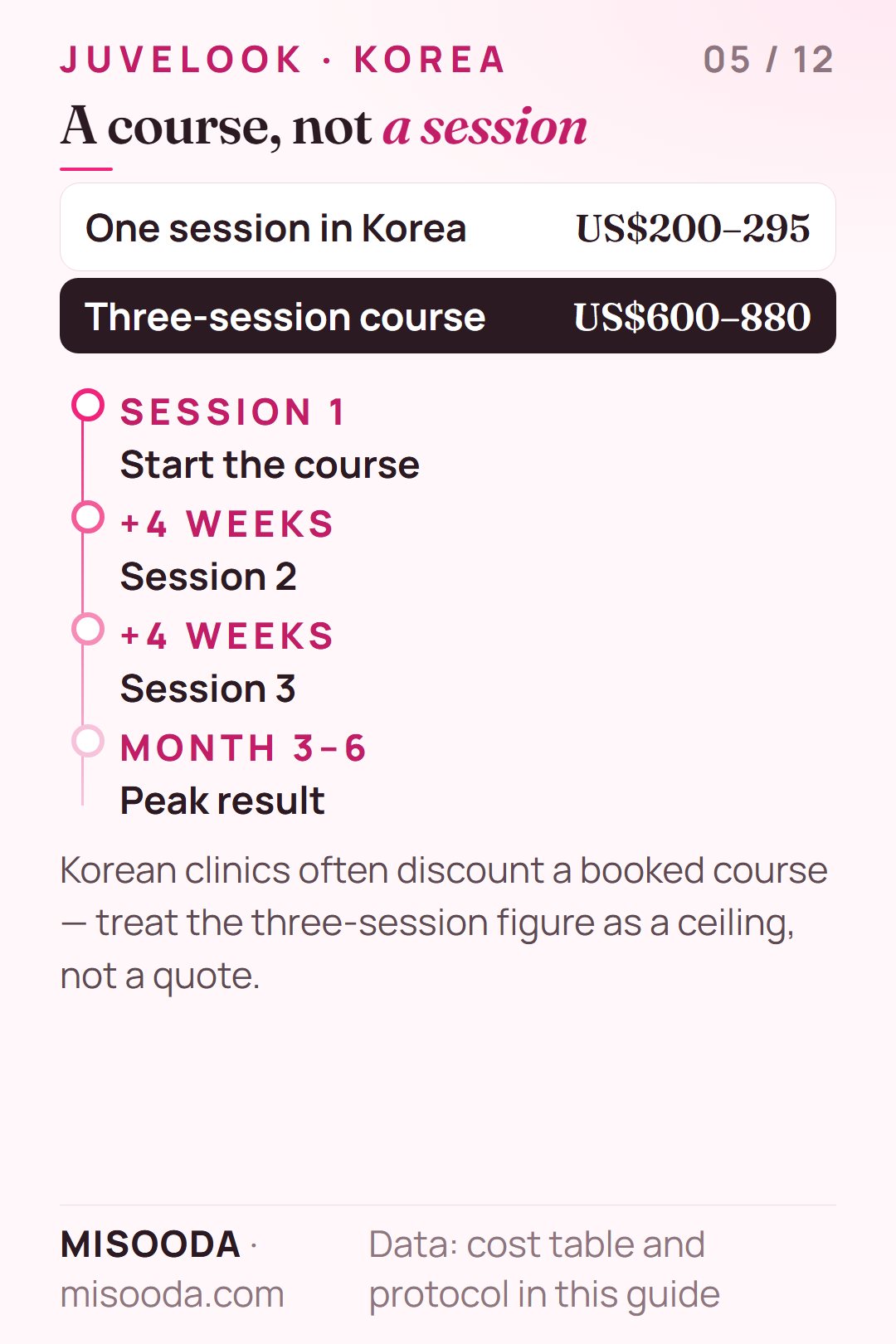
How these numbers were built. The Korean column is the middle band of what MISOODA partner clinics actually charge — the 25th to 75th percentile across our clinic price lists, VAT included, packages excluded. It is a range, not a fixed price, because we work with more than one clinic and route you accordingly. The US column is publicly listed clinic prices as at August 2026 and are deliberately left wide, because that is the real spread in those markets. The Korean three-session figure is one session × 3 — Korean clinics often discount a booked course, so treat it as a ceiling rather than a quote. Converted at US$1 = ₩1,400. These are standing list bands — event and campaign rates are deliberately left out.
Timeline
What it actually is
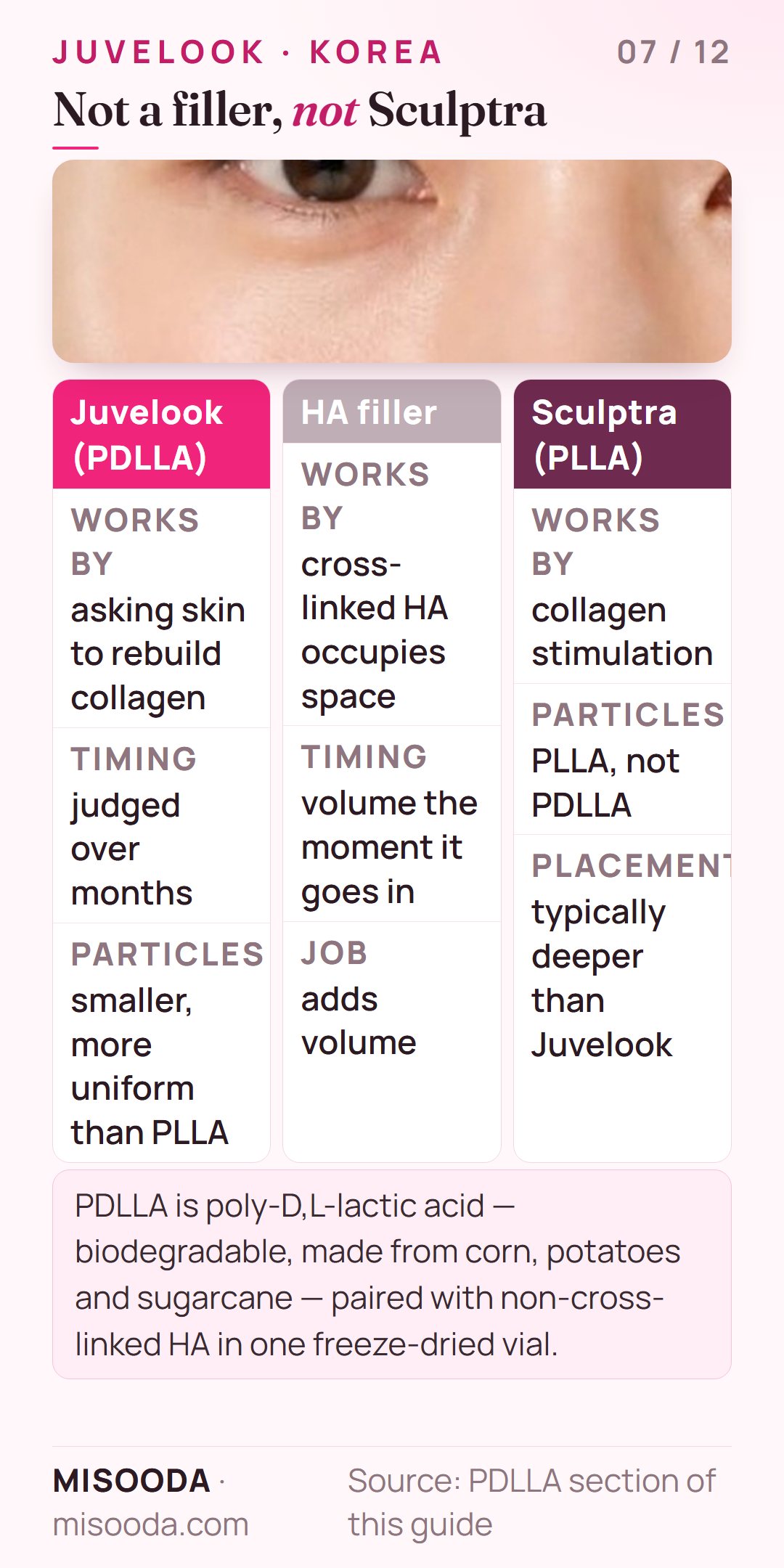
PDLLA is poly-D,L-lactic acid — a biodegradable material made from corn, potatoes and sugarcane. Juvelook pairs it with non-cross-linked hyaluronic acid in a single freeze-dried vial.
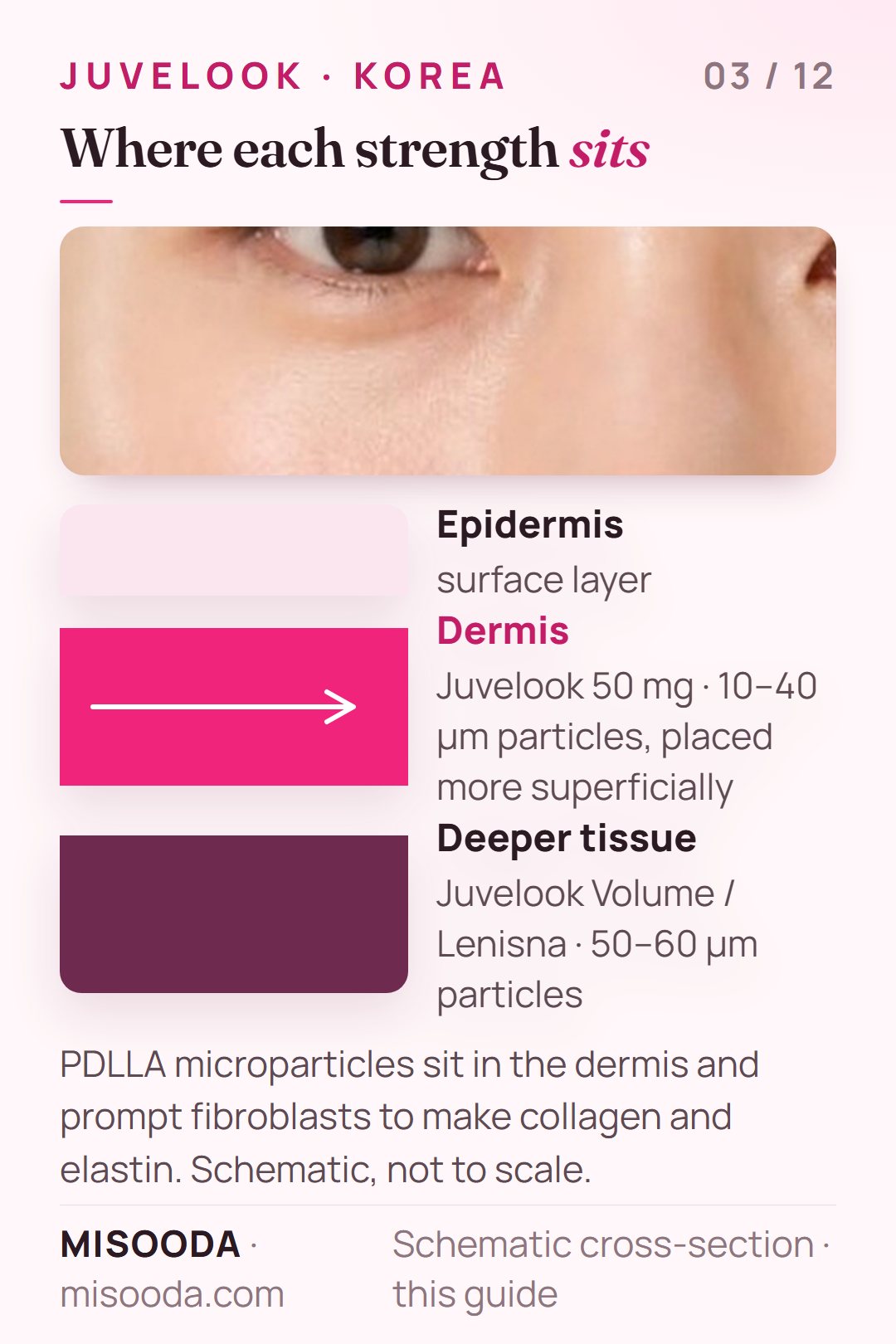
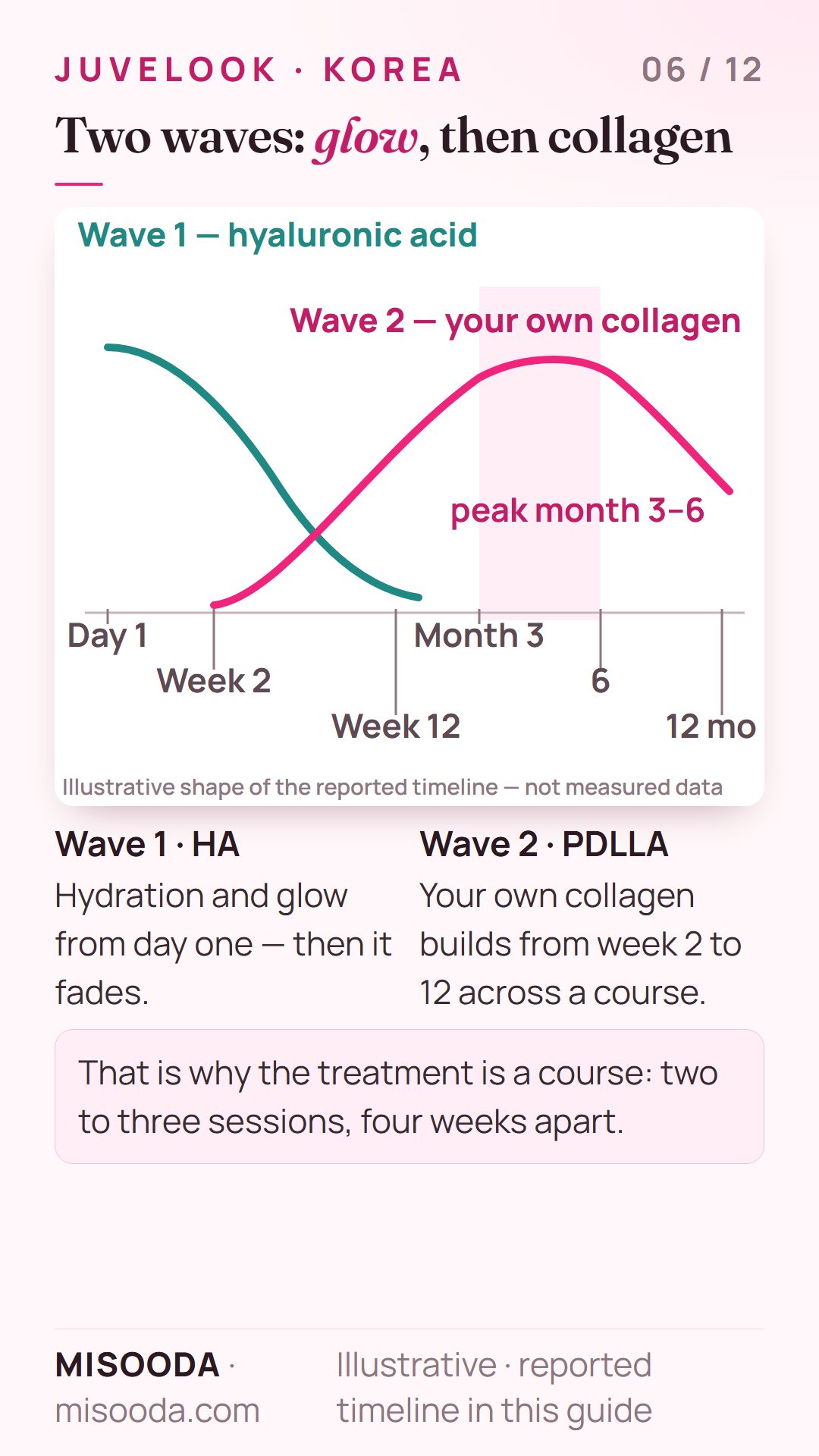
The two ingredients do different jobs on different clocks. The hyaluronic acid hydrates straight away, which is the glow people notice in the first few days. The PDLLA microparticles sit in the dermis and prompt your fibroblasts to lay down collagen and elastin over roughly two to twelve weeks. The first effect is borrowed; the second is yours.
This is not a filler. A cross-linked hyaluronic acid filler adds volume by occupying space, and it does so the moment it goes in. Juvelook does not fill — it asks your skin to rebuild. That is also why it is judged over months rather than on the way out of the clinic.
And it is not Sculptra. Sculptra uses PLLA; Juvelook uses PDLLA, whose particles are smaller and more uniform. That is the reason Juvelook can be placed more superficially than Sculptra typically is.
The risk worth understanding
Nodules are the main thing to understand with any PDLLA product, and most treatment pages skate over it.
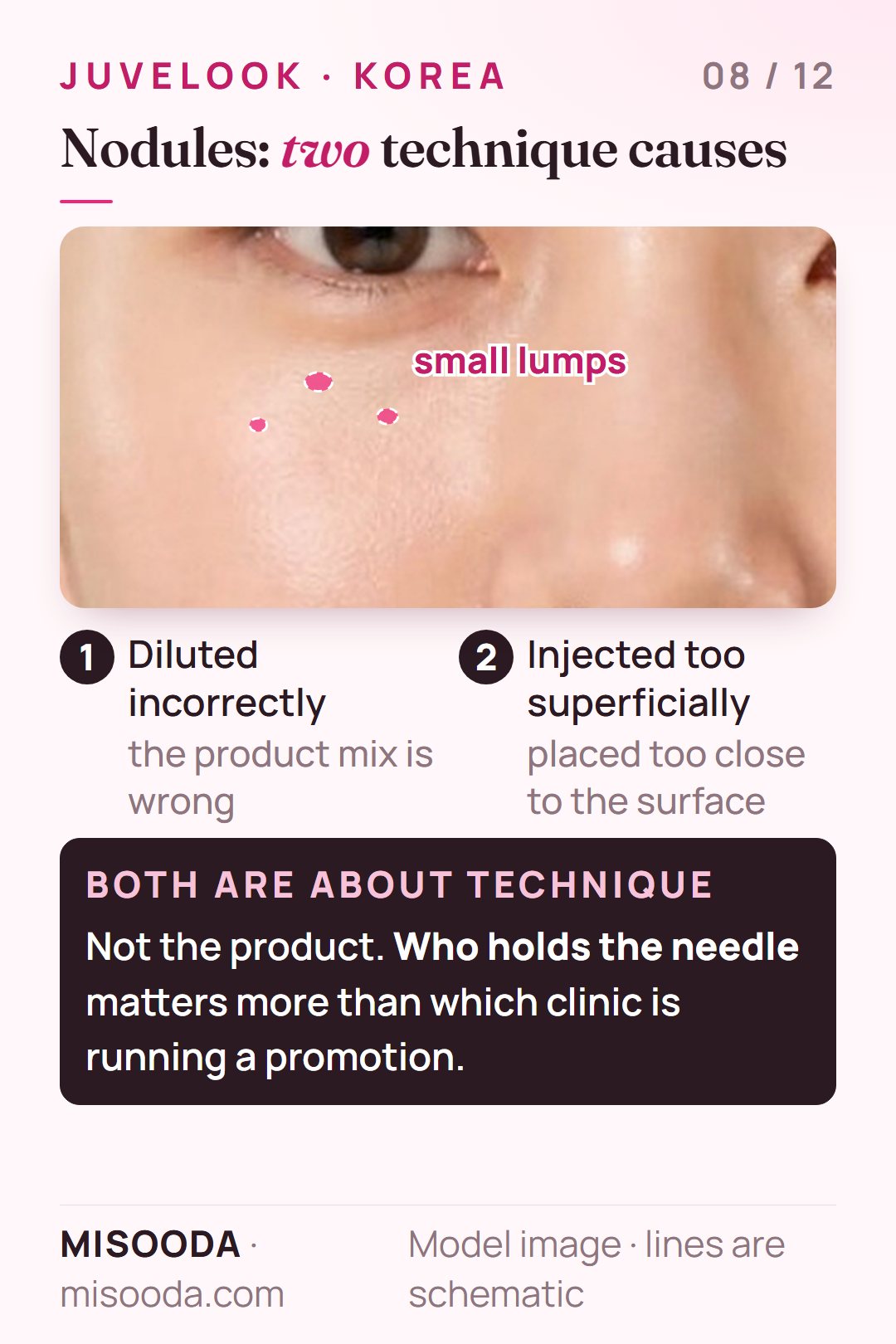
They are small lumps, and they form for two reasons: the product was diluted incorrectly, or it was injected too superficially.
Notice that both are about technique, not about the product. Who holds the needle matters more here than which clinic is running a promotion. That is an uncomfortable thing for a booking platform to write, and it is still true.
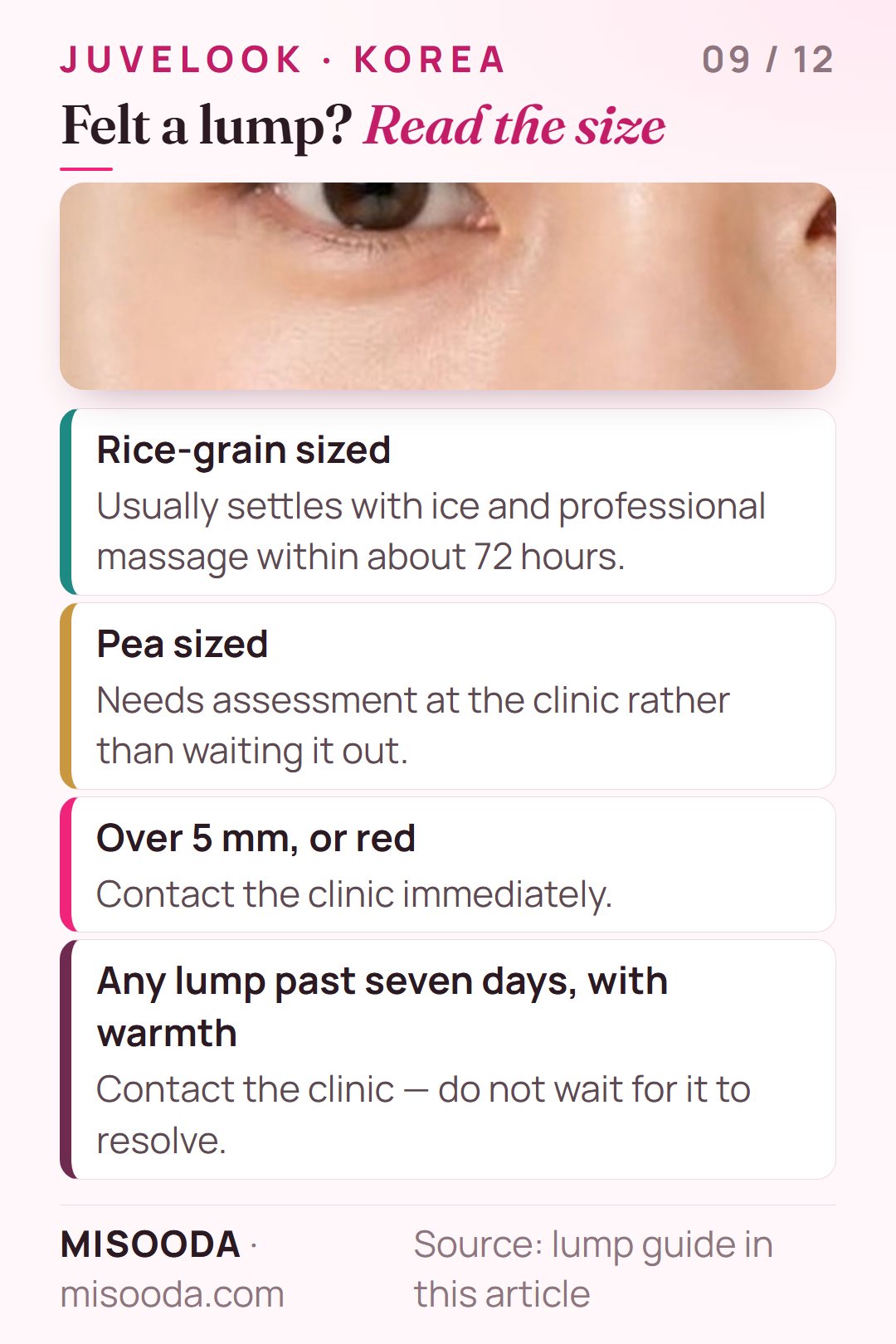
Most small lumps settle in three to five days and are not a complication. The point of the list is knowing which ones are not that. If you have flown home by then, tell us — we stay in the loop with the clinic after you leave.
Safety
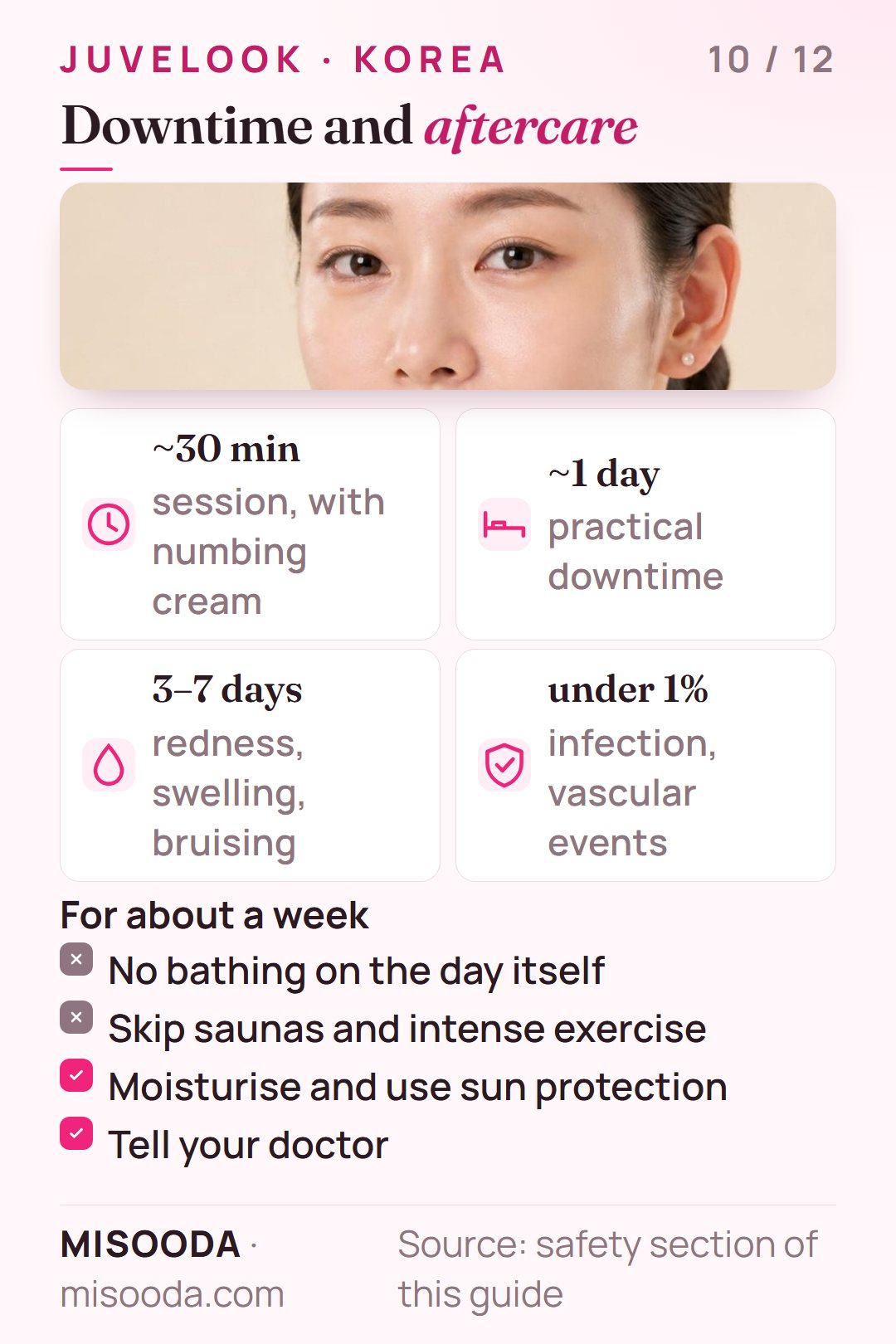
Common and temporary: redness, swelling, bruising and tenderness, generally over 3–7 days. The milder version of that often settles within 24–48 hours. Practical downtime is around a day — most people are back to normal the next morning.
Uncommon: infection and vascular events are reported at well under 1%.
Aftercare: no bathing on the day itself. For about a week, skip saunas, intense exercise and anything else that raises blood flow. Keep the skin moisturised and use sun protection.
Tell your doctor about your medical history, whether you are pregnant or breastfeeding, any active skin infection in the area, and any injectable treatment you have had in the same area recently. Suitability is a clinical judgement, and it needs to be made by the doctor treating you.
Approvals
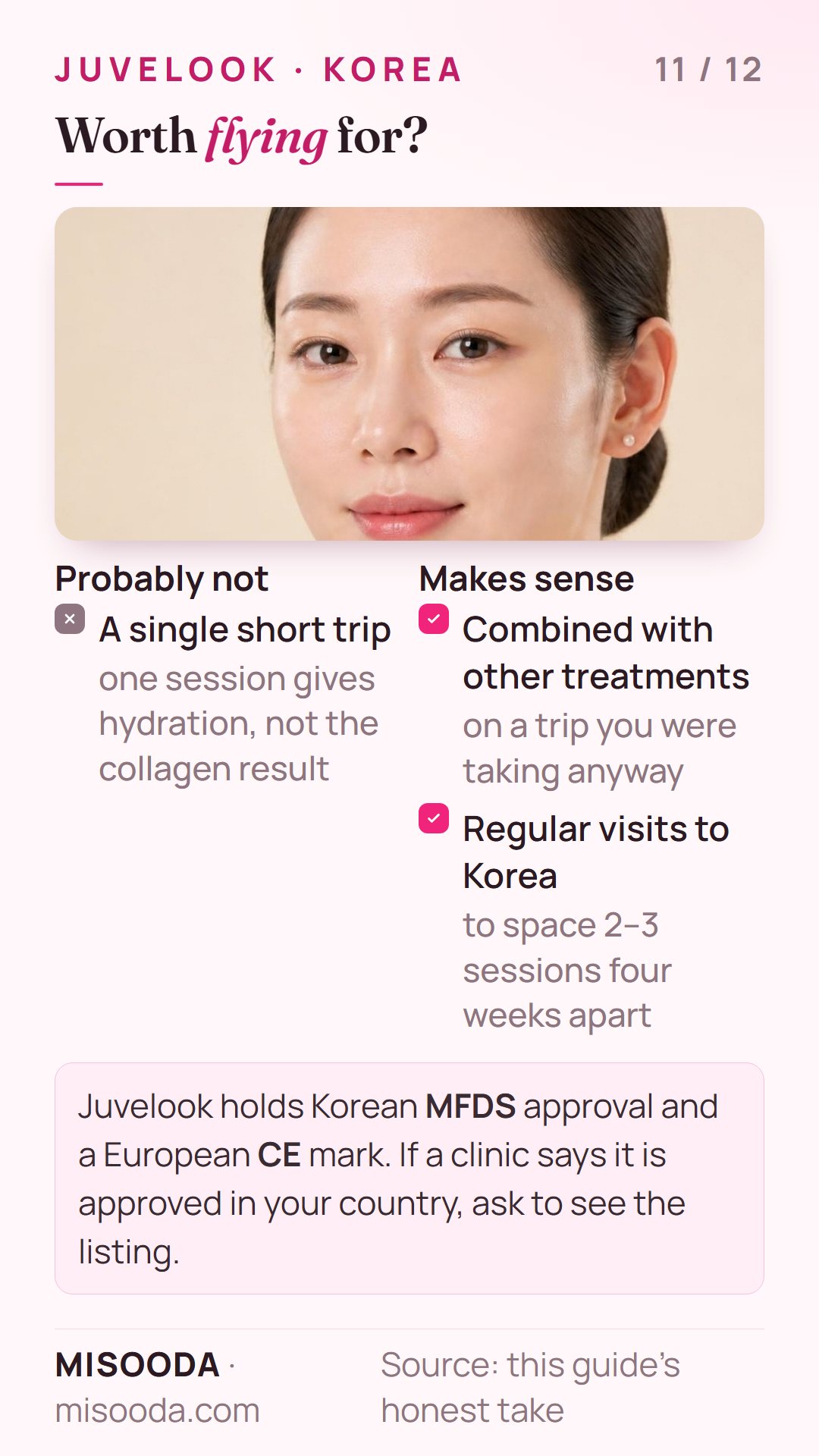
Juvelook holds Korean MFDS approval and a European CE mark.
Beyond that, published claims about its regulatory status in other markets conflict with each other — including on clinic websites. So we are not going to repeat any of them.
If a clinic anywhere tells you a product is approved in your country, ask them to show you the listing. That is a reasonable question and any good clinic will answer it without fuss.
Honestly
On its own, probably not — and we would rather say so.
Juvelook is a course of two to three sessions spaced four weeks apart. That does not fit a single short trip, and doing one session abroad gives you the hydration effect without the collagen result you are actually paying for. The saving is real, but it is a saving on a treatment that wants time.
Where it does make sense: combined with other treatments on a trip you were taking anyway, or if you visit Korea regularly enough to space the sessions properly. Tell us your travel dates and we will tell you plainly whether the plan works.
Booking
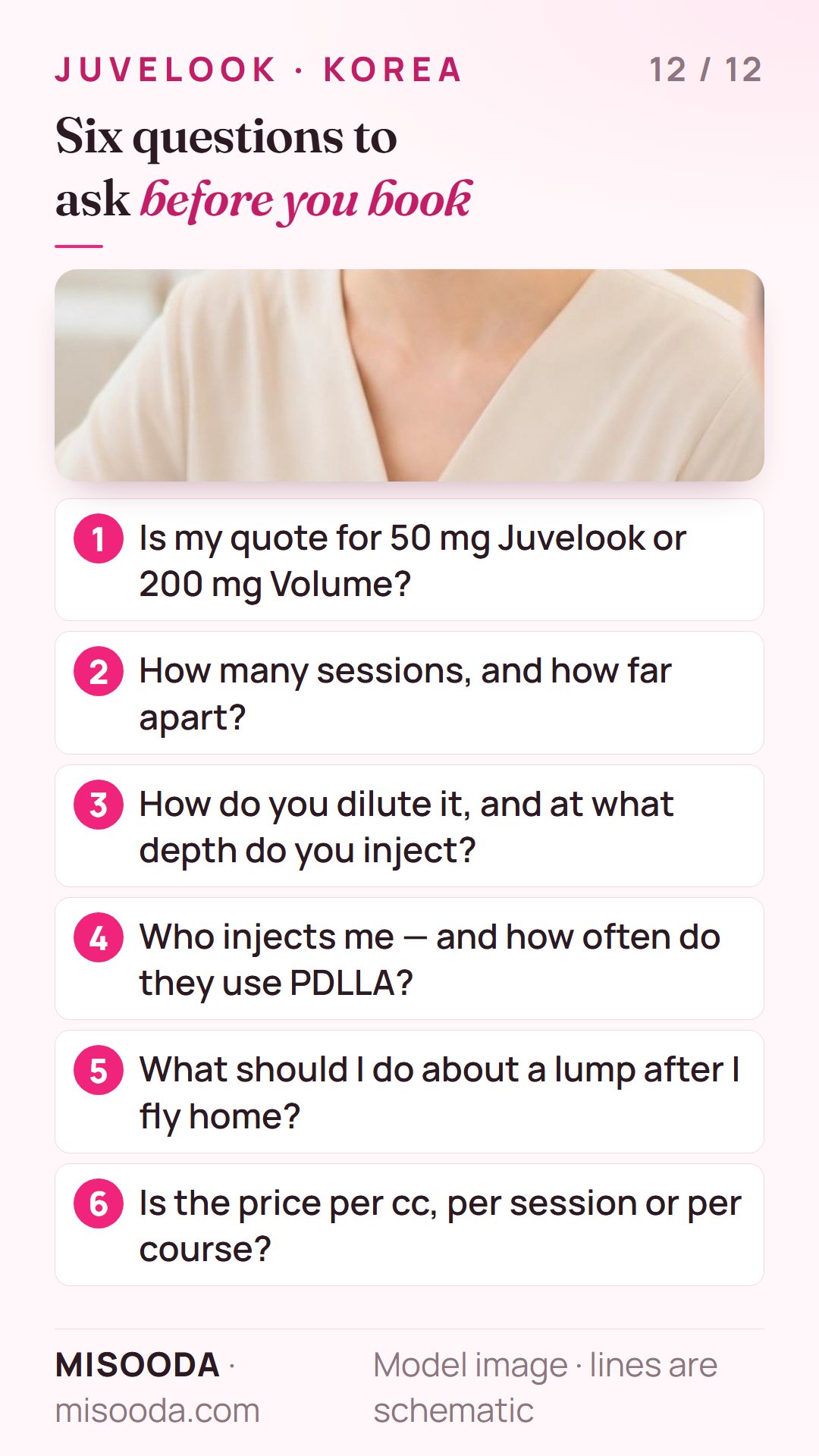
Send your photos and tell us what bothers you. You get an itemised quote across suitable partner clinics — the same price a Korean local pays, no foreigner mark-up, interpreter included.
Because injection technique is what decides your result here, tell us if you have had PDLLA or filler before and how it went. It changes which doctor we put you in front of.
Korea’s VAT refund for cosmetic procedures ended on 1 January 2026. Any page still promising a 7–10% airport refund on aesthetic treatments is out of date.
FAQ
Not quite — Lenisna is the same product as Juvelook Volume, sold under a different name outside Korea. Plain Juvelook (50 mg) and Juvelook Volume / Lenisna (200 mg) are two different strengths: 42.5 mg of PDLLA with 10–40 µm particles for skin quality, against 170 mg with 50–60 µm particles for deeper work.
Poly-D,L-lactic acid — a biodegradable material derived from corn, potatoes and sugarcane. Injected into the skin, its microparticles stimulate fibroblasts in the dermis to produce collagen and elastin over the following weeks.
A cross-linked hyaluronic acid filler adds volume immediately by occupying space. Juvelook works in two waves instead: the non-cross-linked HA gives hydration and glow from day one, then the PDLLA prompts your own collagen over roughly 2–12 weeks. It is a skin-quality treatment, not a volumising one.
Sculptra uses PLLA; Juvelook uses PDLLA. The PDLLA particles are smaller and more uniform, which is why Juvelook can be placed more superficially than Sculptra typically is.
Two to three sessions about four weeks apart is the standard protocol, and some clinicians recommend up to four. A single session will give you the hydration effect but not the collagen result — the course is the treatment.
Hydration and glow from day one, from the HA component. The collagen change builds over roughly 2–12 weeks, and peak results are usually around month 3–6 after finishing the course.
Around 6–12 months for standard Juvelook after a completed course. Juvelook Volume / Lenisna lasts longer — sources put it between 12 and 24 months. Ageing continues either way, so these are maintenance treatments.
A topical numbing cream is applied and a session takes about 30 minutes. Downtime is roughly 24 hours — most people are back to normal the next day. Redness, swelling, bruising and tenderness are common for 3–7 days, and the milder version of that often settles within 24–48 hours.
Nodules are small lumps that can form when the product is diluted incorrectly or injected too superficially — it is the main risk worth understanding with any PDLLA product. Injection depth and dilution are operator-dependent, which is exactly why who injects you matters more than which clinic has a promotion on.
Small lumps often settle in 3–5 days. Rice-grain-sized ones usually respond to ice and professional massage within 72 hours. A pea-sized nodule needs assessment, and anything over 5 mm with redness — or any lump lasting more than 7 days with warmth — means contact the clinic straight away rather than waiting.
No bathing the same day. Avoid saunas, intense exercise and anything that raises blood flow for about a week. Keep the skin moisturised and use sun protection.
It holds Korean MFDS approval and a European CE mark. We deliberately do not make claims about its status in other markets — regulatory listings differ by country and you should ask your own clinic to show you what applies where you are.
Korea is the launch market and the manufacturer's home market, so there are far more clinics offering it and real price competition between them. A session runs about US$200–295 in Korea against US$700–1,200 in the US.
On its own, probably not — it is a course of 2–3 sessions four weeks apart, which does not fit a short trip well. It makes more sense combined with other treatments, or if you are already visiting. We will tell you honestly if the maths does not work for you.
No. Korea's VAT refund for cosmetic procedures ended on 1 January 2026. Any site still advertising a 7–10% airport refund on aesthetic treatments is out of date.
Send photos and tell us what bothers you. You will get an itemised quote across suitable partner clinics, at the same price a Korean local pays, with an interpreter included.